


Annual report for the 2024 to 2025 fiscal year: Putting people at the centre of our service

Message from the Chairperson
The Social Security Tribunal (SST) works across Canada, including on traditional Indigenous territories. Our Secretariat is located in Ottawa, on the unceded territory of the Anishinaabe Algonquin Nation. As part of our continued commitment to reconciliation, I want to share my respect and gratitude for the land we’re on and the peoples who have cared for it for generations.
In the 2024 to 2025 fiscal year, the SST remained focused on providing fair, quick, and inclusive services for people challenging decisions about their Canada Pension Plan (CPP), Old Age Security (OAS), and Employment Insurance (EI) benefits. These benefits are an important part of Canada’s support system, and we’re committed to ensuring everyone can participate meaningfully in the appeal process. Putting people at the centre of our service guides everything we do.
With this in mind, we aim to give people their decisions as soon as a fair process allows. Building on last year’s progress, we now have a manageable inventory of appeals across the SST, with no backlogs. Our processing times for hearing and concluding appeals have dropped further. People consistently report that they’re satisfied with our appeal processes.
The human connections we make every day are at the core of our work. Liaison officers and navigators play a key role in supporting people across the country. They answer questions, identify needs, and connect callers to help, including community organizations or distress resources when needed. Members provide information about the law and the appeal process during each hearing. These services reflect our commitment to accessible justice.
In this report, you’ll learn more about the initiatives we’ve undertaken this year. You can read our decision highlights and review our statistics. If you have questions or comments, please reach out – we’re always looking for ways to improve further.

Shirley Netten
Chairperson
Social Security Tribunal
Year at a glance

Text version
We completed 7,593 appeals
- Income Security
- General Division 2,341
- Appeal Division 248
- Employment Insurance
- General Division 4,137
- Appeal Division 696
Hearing type
- 14% in person
- 48% by teleconference
- 24% by videoconference
- 15% in writing
We surveyed appellants to find out how satisfied they were with the appeal process.
- 95% felt they were able to participate fully in their hearings
- 90% were satisfied overall
85.6% of appellants didn’t have professional representation
- Self-represented: 73.7%
- Other types of representation: 11.9%
- Professional representation: 14.4%
- The navigator service helped people in 1,636 concluded appeals
- Our call centre processed 16,553 calls
- We published 1,856 decisions opens a new window
- Our website got 76,543 visits overall (with 53,074 unique visitors)
Text version
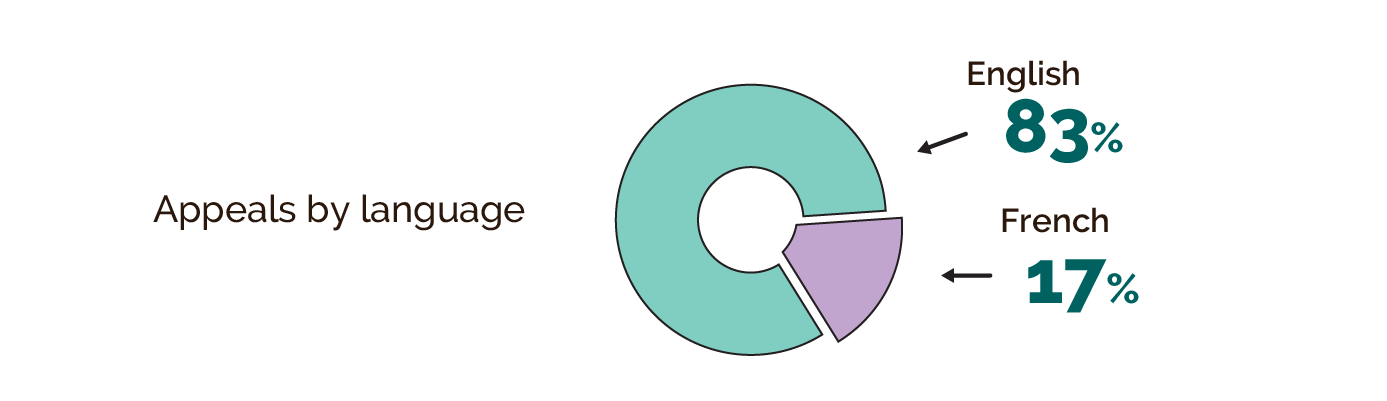
Appeals by language
- 83% of appeals were filed in English
- 17% in French
Text version
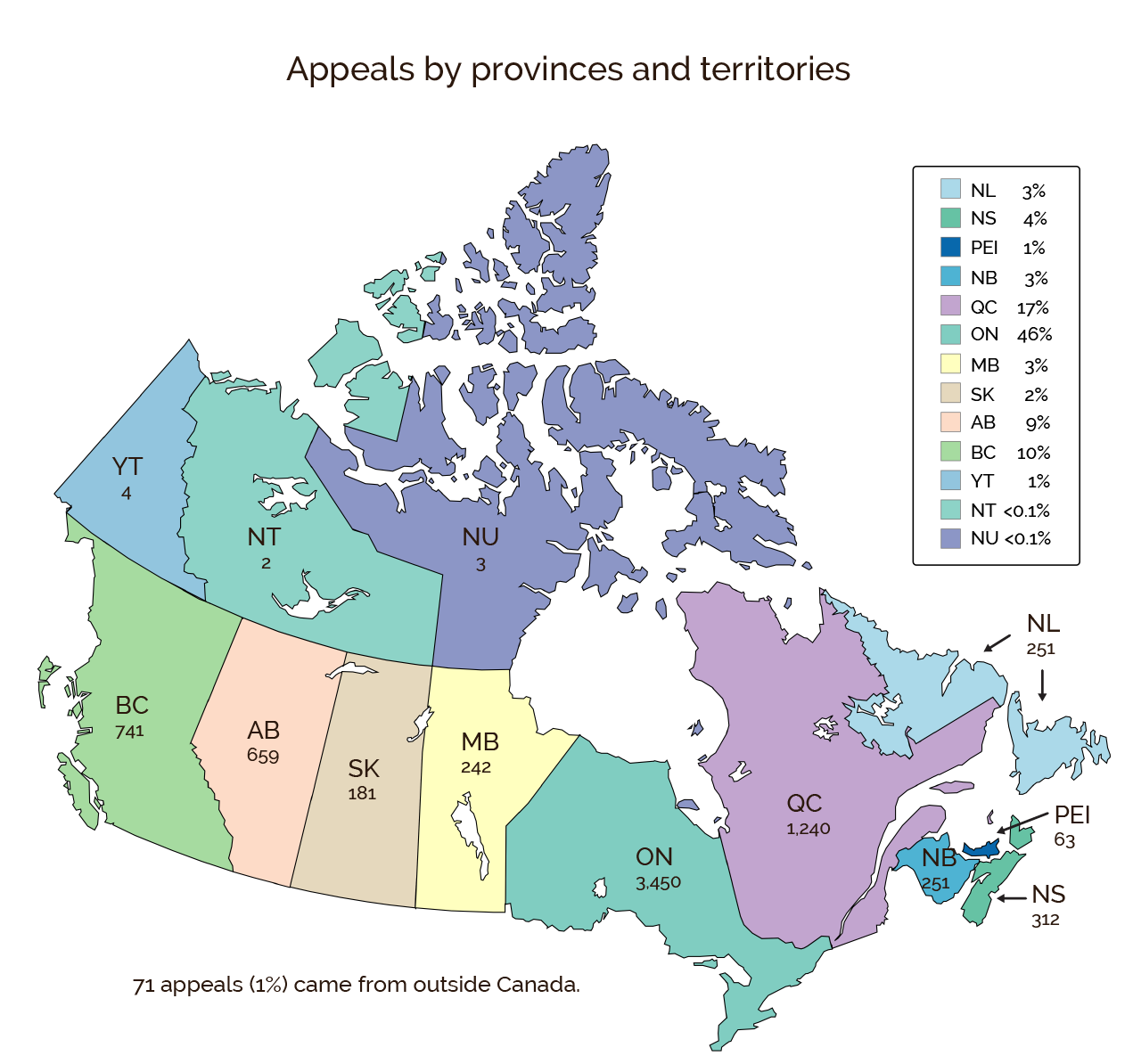
Appeals by provinces and territories
- 741 British Columbia (10%)
- 659 Alberta (9%)
- 181 Saskatchewan (2%)
- 242 Manitoba (3%)
- 3,450 Ontario (46%)
- 1,240 Quebec (17%)
- 251 New Brunswick (3%)
- 312 Nova Scotia (4%)
- 63 Prince Edward Island (1%)
- 251 Newfoundland and Labrador (3%)
- 4 Yukon 1%
- 2 Northwest Territories (less than 0.1%)
- 3 Nunavut (less than 0.1%)
71 appeals (1%) came from outside Canada.
Who we are and what we do
Text version
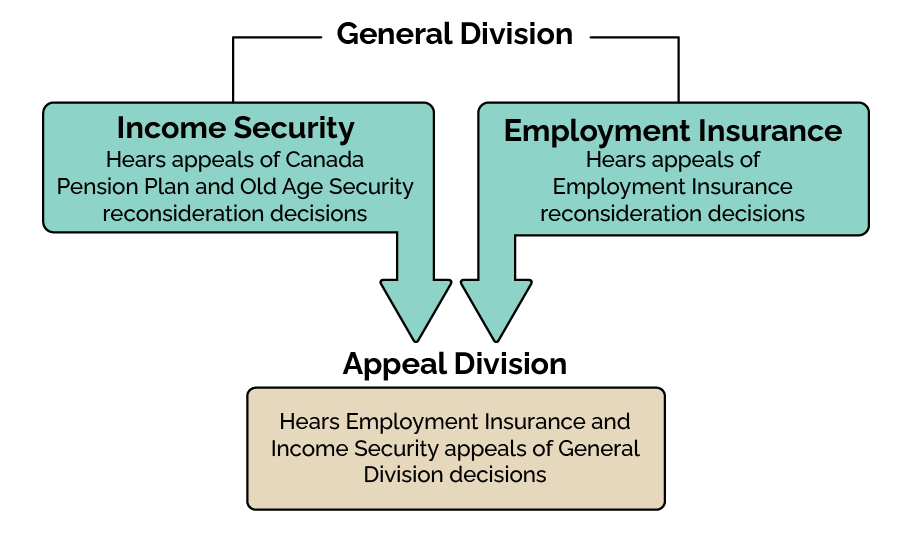
- General Division
- Income Security: Hears appeals of Canada Pension Plan and Old Age Security reconsideration decisions
- Employment Insurance: Hears appeals of Employment Insurance reconsideration decisions
- Appeal Division: Hears Income Security appeals and Employment Insurance appeals of General Division decisions
The SST decides appeals about these benefits:
- CPP disability and other CPP benefits
- OAS including the Guaranteed Income Supplement (GIS)
- EI
The SST has 2 levels of decision-making and is led by a chairperson and 3 vice-chairpersons. At the end of the 2024 to 2025 fiscal year, we had 68 members.
We’re supported by the Administrative Tribunals Support Service of Canada (ATSSC). Our Secretariat, led by an executive director, has about 200 employees. They provide us with registry, legal, outreach, evaluation, member and corporate services.
We operate at arm’s length from the Government of Canada. We don’t work for Employment and Social Development Canada, Service Canada, or the Canada Employment Insurance Commission. Learn more about how we work within government.
Spotlight on accessibility and inclusion
We want the appeal process to be accessible and welcoming for everyone. To do this, we’re putting equity, diversity, and inclusion into practice every day. These are some steps we’ve taken this year.
Our first video
We were excited to launch a video in March to explain what to expect at a CPP disability hearing.
The video walks you through a typical CPP disability hearing from start to finish and addresses common questions and concerns. It applies to both General Division and Appeal Division hearings.
Adding video to our toolkit gives a different way to access information, so the people who participate in our appeal process feel more prepared. Stay tuned for more videos in the future!
Enhancing the navigator service
Appealing to an administrative tribunal can be overwhelming. The navigator service builds relationships with parties and makes the process more accessible and user-friendly. Navigators are trained to support and guide parties who don’t have a professional representative (like a lawyer) through the appeal process. Through this support, parties are empowered and feel better prepared for their appeal.
In 2023, an independent research firm prepared a report opens a new window about the navigator service at the Appeal Division. The report made several recommendations based on feedback from 20 people who used the service. In 2024, we developed a management response and action plan to address these recommendations, including the launch of the Navigator Reinforcement Project. Our goal is to develop a plan to improve the service to respond even more to the needs of people who don’t have professional representation.
At the General Division, navigators are available for:
- OAS and GIS appeals
- CPP disability and other CPP appeals
- EI Charter challenges and EI group appeals
At the Appeal Division, navigators are available for any type of appeal once you have permission to appeal.
Helping people find useful decisions
When people read decisions on cases like theirs, it can help them understand how the law works and how SST members make their decisions. Appellants can also present cases as part of their arguments in an appeal.
This year, we created a new web page about finding decisions on cases like yours that goes over each feature of our advanced decision search tool. The goal is for people to understand each feature so that they can get the best results.
Finding relevant decisions is only the beginning. We also have a page explaining how to use those decisions to help with an appeal. And we trained our navigators so they can explain how to find and use SST decisions.
We also have more decisions with a helpful summary, which people can filter for under “Featured decisions.” What’s more, we improved the subject search results so that people will find more decisions than ever before no matter what subject they choose in the advanced decision search.
Using more inclusive language
In 2023, we asked an external expert to look at some of our documents like decisions, letters, and forms for inclusive language. Their report showed that we’ve improved our use of inclusive language since we adopted a new SST Style Guide in August 2021. Still, there’s always room for improvement.
This year, we put in place a management response and action plan to act on the report’s recommendations. Some of the steps we’ve taken include:
- using different terms and wording when appropriate
- promoting inclusive writing internally
- improving guidance on gender-neutral writing in French
Learning about the people who come to the SST
This year, we continued to gather data to better understand the people who use our service. We asked new appellants at the General Division 20 questions about things like their:
- access to technology
- gender
- age
- income
We learned a lot about them. For example, about 40% said they don’t have a computer, and more than 10% speak a language other than English or French at home. This helps us identify barriers so we can work to reduce them and make our appeal process as accessible and inclusive as possible.
So far, information about language, income, digital access, geography, and other data has helped us:
- expand interpretation services beyond hearings to navigator services for people who don’t speak English or French
- explore ways to address digital barriers that make it harder for seniors, low-income individuals, and people in rural areas to participate fully in their appeal process
- identify more organizations that can help, recognizing that access to legal help and community services varies across provinces and territories, especially for newcomers and people who don’t speak an official language
Our goal of equity, diversity, and inclusion (EDI)
Last year, we developed a robust EDI framework centred around these 5 core pillars:
- leadership
- a safe workplace
- representation
- awareness
- service to the public
This year, we’ve done the following:
- designed a framework to help track our progress
- started creating a collection of EDI resources that staff and members can easily access
In the 2025 to 2026 fiscal year, we’ll focus on working on the activities identified under the framework.
Continuing to seek stakeholder input
We’re always looking for ways to serve people better. To do this, we meet with our stakeholders through our Employment Insurance Appeals Consultative Committee and Income Security Appeals Consultative Committee to discuss our work and get feedback.
This year, stakeholder input helped us:
- design the process for Canada Disability Benefit appeals at the General Division and Appeal Division
- develop a new practice direction for using earlier testimony in Income Security appeals at the Appeal Division
- strengthen our outreach efforts to better support appellants
Updates to our Rules of Procedure
In December, we consulted on proposed changes to our Rules of Procedure opens a new window. In March, we finalized changes to the Rules that:
- simplify certain processes and clarify the meaning of particular rules
- reflect the SST’s new mandate to hear appeals under the Canada Disability Benefit Regulations opens a new window
The first set of changes to the Rules opens a new window and the second set of changes to the Rules opens a new window both took effect on May 2025.
Decision highlights
Income Security appeals
Most Income Security appeals are about the CPP disability pension. If a person applies for a disability pension, they have to prove that their disability is severe and prolonged by a certain date. They need at least some objective medical evidence to prove this.
CPP disability pension – objective medical evidence
In JR v Minister of Employment and Social Development, 2024 SST 1306 opens a new window , the General Division found that there wasn’t any objective medical evidence that the Appellant had functional limitations affecting her ability to work by December 31, 2003. The Appellant’s doctor began treating her in 2011 and didn’t have access to her older medical records. So, the doctor’s evidence was not objective medical evidence of disability in 2003. Also, the employer’s letter from 2003 mentioning what the Appellant’s doctor had said about her condition was not objective medical evidence.
Without objective medical evidence, the Appellant wasn’t entitled to a CPP disability pension.
The Post-Retirement Disability Benefit (PRDB) is for people who become disabled before age 65 but after starting their retirement pension. The Appeal Division looked at whether new provisions about eligibility for the PRDB applied retrospectively.
PRDB – new provisions don’t apply to older claims
The minimum qualifying period to get the PRDB changed on May 5, 2023. You still need at least 3 years of valid contributions in a 6-year period, but the way the 6-year period is calculated has changed.
Does this apply to PRDB claims made before May 5, 2023? No. The Appeal Division found that the new provisions don’t apply retrospectively: Minister of Employment and Social Development v LG, 2024 SST 1315 opens a new window and MW v Minister of Employment and Social Development, 2024 SST 1480 opens a new window .
A person may be eligible for the Allowance if they’re between 60 and 64 and their spouse or common-law partner gets the GIS. A person will no longer be eligible 3 months after separation.
Allowance – being separated
In this case, the Appeal Division had to decide when the Appellant and the Added Party had separated. It found that the Allowance is intended to provide financial assistance to spouses who are in a spousal relationship. So, a couple is separated when one of them considers the relationship to be over and their behaviour convincingly shows that their decision is final. In other words, it’s not a simple question of whether they still live in the same home.
There was no chance the couple could get back together after an incident in January 2013. Also, their behaviour after that date convincingly showed that the decision was final. The Appeal Division found that the couple was no longer in a spousal relationship: CT v Minister of Employment and Social Development and EM, 2024 TSS 1350 opens a new window .
Employment Insurance appeals
In 2020, many Canadians received the EI Emergency Response Benefit (EI ERB, sometimes called CERB). In certain cases, a combination of the advance payment and ongoing EI ERB payments led to benefits being overpaid. The SST hears many appeals from people disputing the amount they’ve been asked to pay back.
EI Emergency Response Benefit
The law says that, if someone received more of the EI ERB than they were eligible for, they have to pay back the overpayment. To see if there’s an overpayment, the SST decides how many weeks of benefits the person was entitled to and compares this to how much they got.
As reported last year, the Appeal Division found that one way to get the EI ERB was having no income for at least 7 days in a 2-week period. Since then, the Appeal Division has confirmed that the EI ERB was payable for 2-week periods, not 1 week at a time. Some people who got benefits for only 1 week of a 2-week period were entitled to an extra week of benefits – and this could reduce how much they have to pay back. That’s what happened in NG v Canada Employment Insurance Commission, 2024 TSS 1563 opens a new window and JG v Canada Employment Insurance Commission, 2024 SST 1169 opens a new window .
Under section 52 of the Employment Insurance Act, the Commission (or Service Canada on its behalf) has the discretion to go back and change the initial decision on a claim. Sometimes, claimants argue that the Commission should not have done so. In these appeals, the member decides whether the Commission exercised its discretion properly.
Commission’s discretion to reconsider initial claims without a request
The Commission has to look at relevant factors and ignore irrelevant ones when deciding whether to reconsider an initial decision. In Canada Employment Insurance Commission v AS, 2024 SST 1366 opens a new window , the member summarized the Appeal Division’s approach:
The Tribunal’s Appeal Division says the Commission should consider factors that favour finality (claimants should be able to rely on Commission decisions) or accuracy (mistakes and misrepresentations should be corrected). This includes the factors in its reconsideration policy. The Appeal Division [says] the Commission should not consider the claimant’s personal factors—such as the ability to pay or stress.
The claimant in this case received EI as a student during the pandemic. The temporary power to verify a student’s availability after the fact (section 153.161(2)) also had to be taken into account when deciding whether to reconsider the initial decision.
The Federal Court of Appeal has found this approach to be reasonable in several cases, such as Al-Harbawi v Canada (Attorney General), 2024 FCA 148 opens a new window and Puig v Canada (Attorney General), 2024 FCA 48 opens a new window .
In Canada Employment Insurance Commission v MM, 2024 SST 1567 opens a new window , the Appeal Division interpreted one of the policy factors the Commission must consider when exercising its discretion: whether benefits were paid in a way that was contrary to the structure of the EI Act. The Appeal Division said that the number of weeks of benefits is at the core of the Act. So, the Commission was correct to consider that the claimant received more weeks of benefits than the law allowed, when it decided to change the initial payment decision.
Workers sometimes receive a lump sum payment when a new collective agreement begins. Why the lump sum was paid can affect EI payments.
Lump sum payment
In Canada Employment Insurance Commission v AC, 2024 SST 1261, opens a new window the claimant received $2,500 from her employer while she was getting EI parental benefits. The Commission said the payment was a bonus for signing the collective agreement. This meant the payment would be assigned to the week it was paid, and the claimant would have to repay the EI she got that week.
The Appeal Division considered whether the payment was a retroactive pay increase, a signing bonus, or payment for past work. The evidence led it to find that the lump sum was payment for past work. This meant the payment was allocated to that past period, without affecting the claimant’s EI benefits. The Commission has since applied the reasoning in this decision in other appeals about the same $2,500 lump sum payment received by other workers.
Appeal procedures
In Income Security appeals, a party who wants someone else to testify at their hearing must send witness details by their filing deadline. A member can decide the party doesn’t have to follow this rule if it is in the interest of justice.
Late witness notice
The Appellant’s professional representative sent a witness notice several months after the filing deadline, and just a few days before the hearing. The General Division decided the witness could not testify. The representative could have sent the notice earlier, even if she wasn’t sure the witness would be needed. It didn’t matter if other members had allowed late witness notices in other appeals. The requirement to file a notice had been in place since December 2022. And, the hearing would still be fair without the witness testimony because the Appellant could provide similar evidence: EH v Minister of Employment and Social Development, 2024 SST 1282 opens a new window .
People sometimes want to appeal the General Division’s interlocutory decision – a decision made during the appeal process that does not bring the appeal to its end.
Appeals of interlocutory decisions to the Appeal Division
The Appeal Division has consistently said that, unless there are exceptional circumstances, it won’t consider appeals of interlocutory decisions until the General Division has given its final decision in the appeal. This avoids delays and back-and-forth between the General and Appeal Divisions.
There were no exceptional circumstances to go ahead right away with an appeal about a Charter challenge, or about appeals related to procedural, legal, and factual errors. These appeals were premature and the Claimant had to wait for the end of the General Division proceedings: BG v Canada Employment Insurance Commission, 2024 SST 1683 opens a new window , and DS v Canada Employment Insurance Commission, 2024 SST 342 opens a new window .
In contrast, there were exceptional circumstances in DS v Minister of Employment and Social Development and MS, 2025 SST 202 opens a new window . The Applicant wanted to appeal the General Division’s interlocutory decision to add M. S. as a party to the appeal. Since it’s important to have the right parties participate at the General Division, the Appeal Division did not wait for the end of the General Division proceedings.
The SST decides these and many other issues under the Canada Pension Plan, Old Age Security Act, and Employment Insurance Act. You can browse published decisions in our decision database or search by case number, subject, date, appeal level, or result. Our database now has almost 16,000 decisions.
Our Income Security numbers
General Division
Inventory
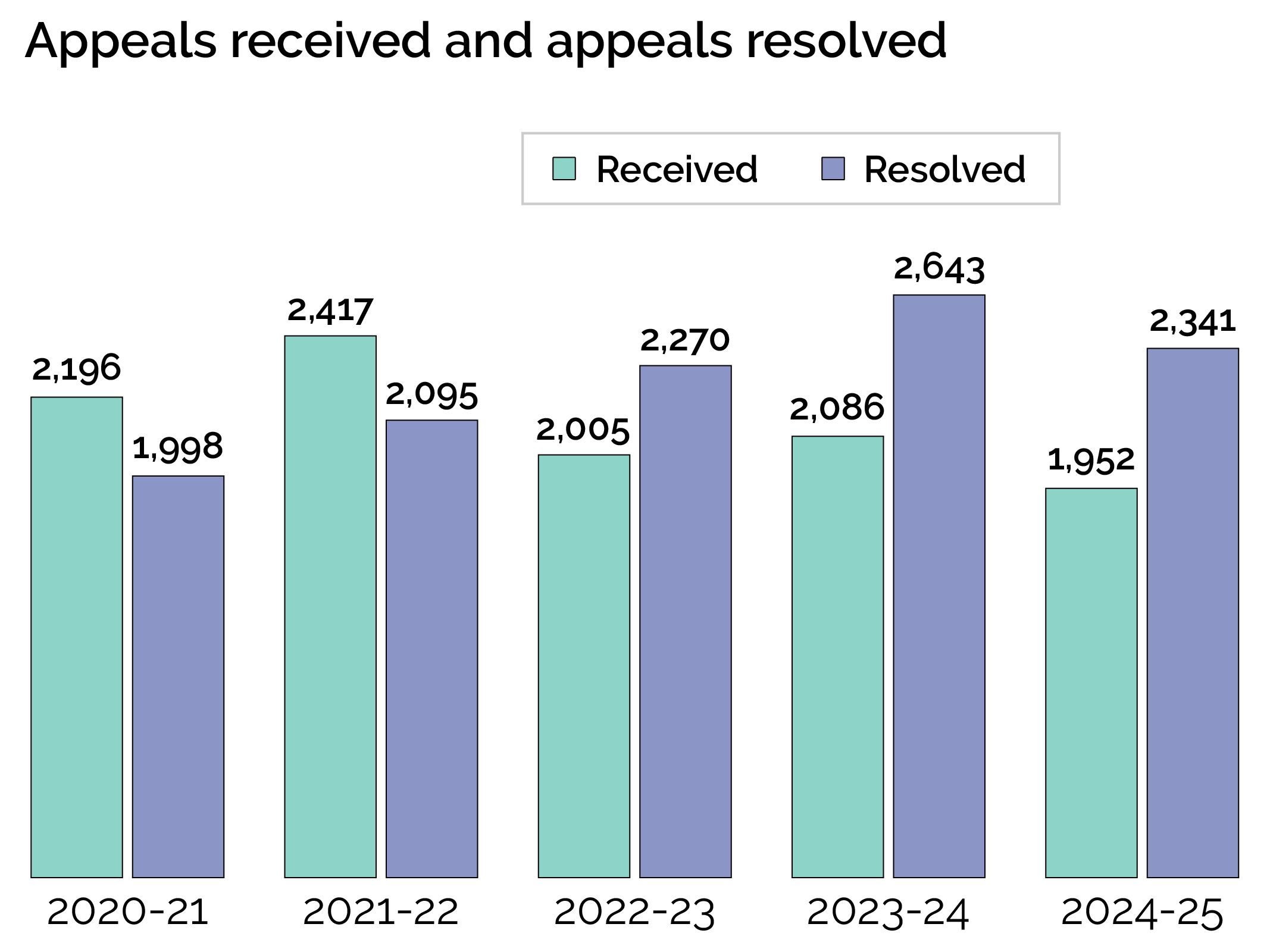
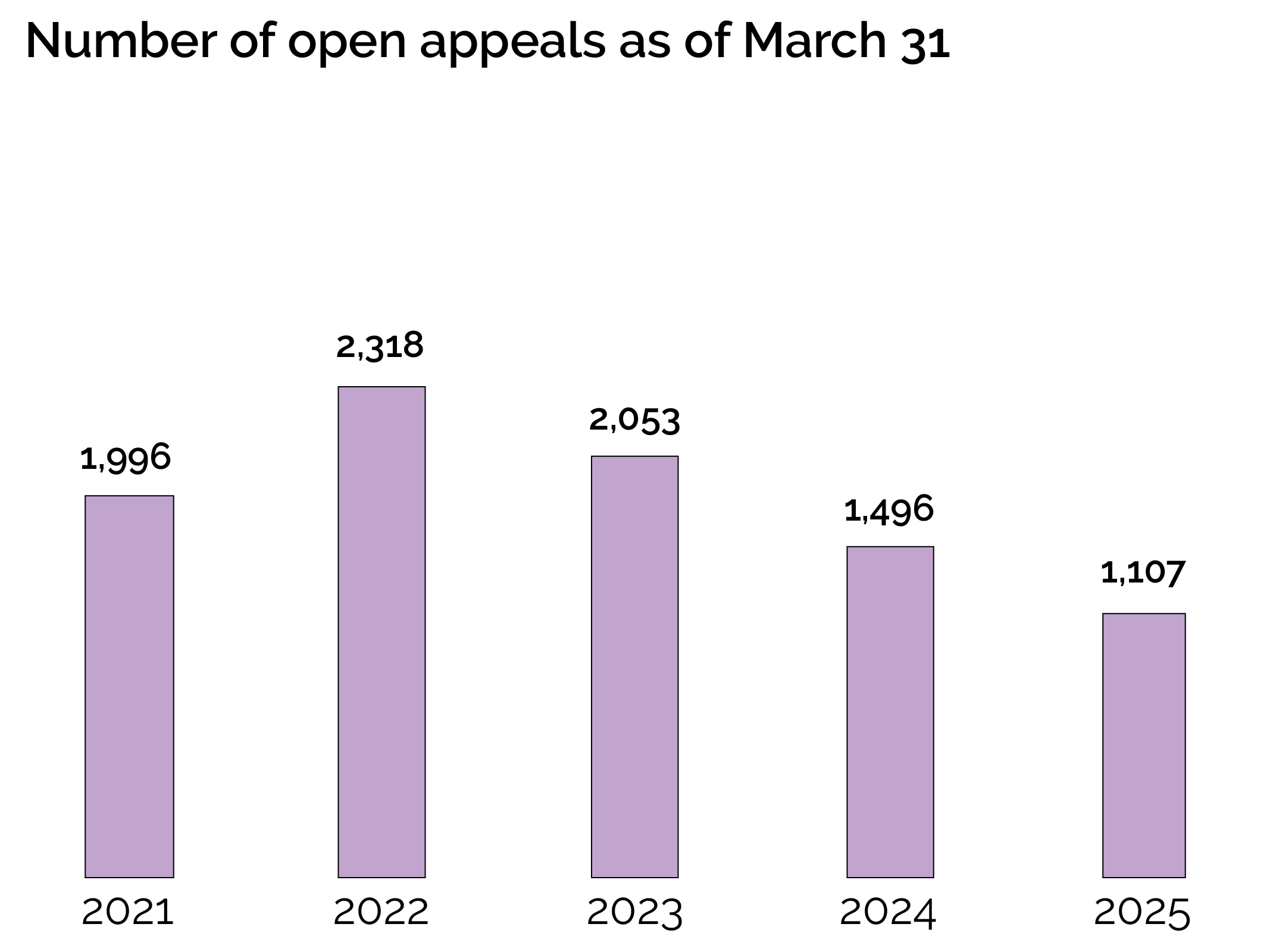
We resolved many more appeals than we received this year. Our inventory of open appeals steadily decreased.
Text version
Appeals received and appeals resolved.
In 2020 to 2021, we received 2,196 appeals and resolved 1,998 appeals.
In 2021 to 2022, we received 2,417 appeals and resolved 2,095 appeals.
In 2022 to 2023, we received 2,005 appeals and resolved 2,270 appeals.
In 2023 to 2024, we received 2,086 appeals and resolved 2,643 appeals.
In 2024 to 2025, we received 1,952 appeals and resolved 2,341 appeals.
Text version
Number of open appeals as of March 31.
On March 31, 2021, there were 1,996 open appeals.
On March 31, 2022, there were 2,318.
On March 31, 2023, there were 2,053.
On March 31, 2024, there were 1,496.
On March 31, 2025, there were 1,107.
Processing times
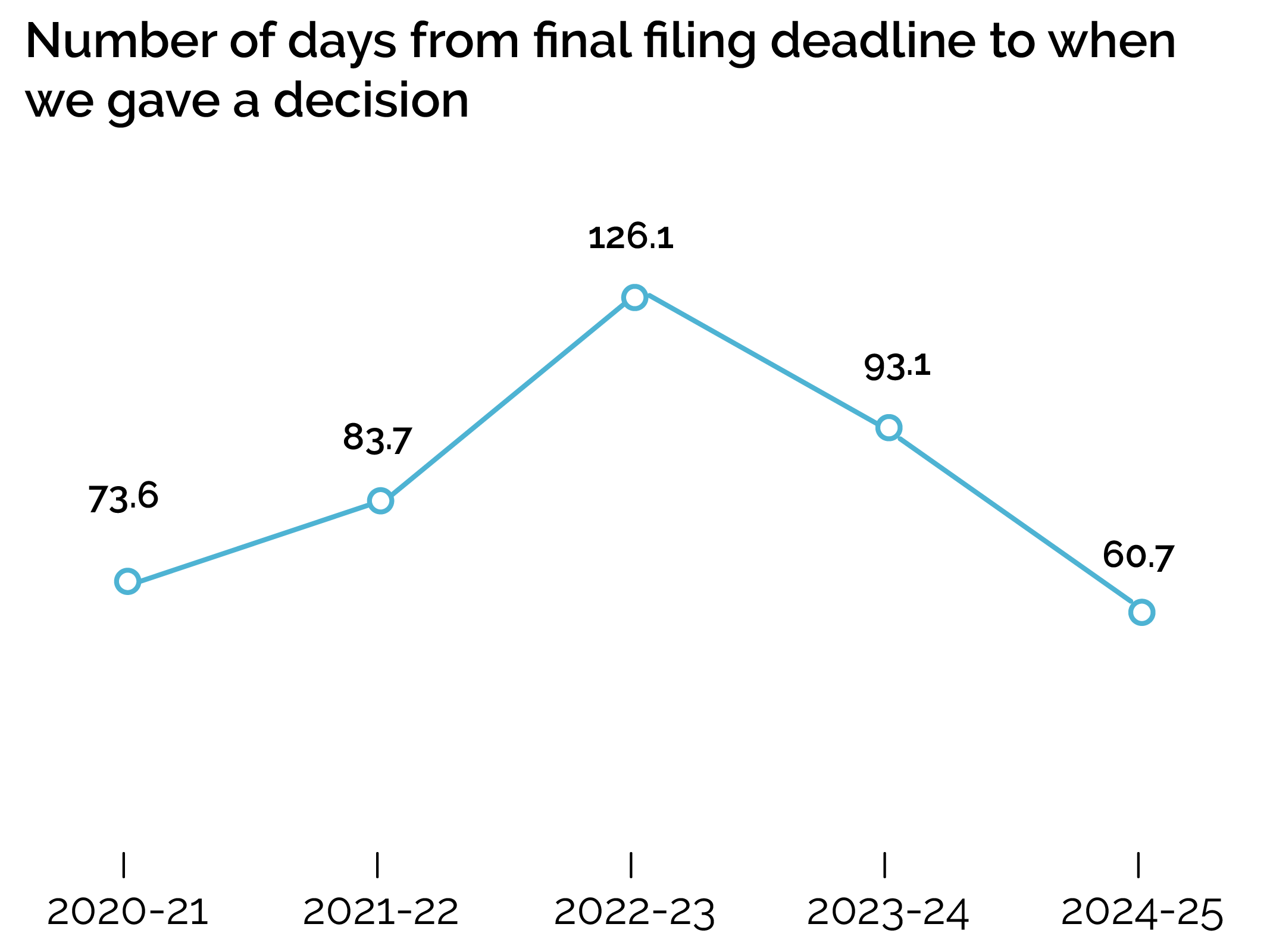
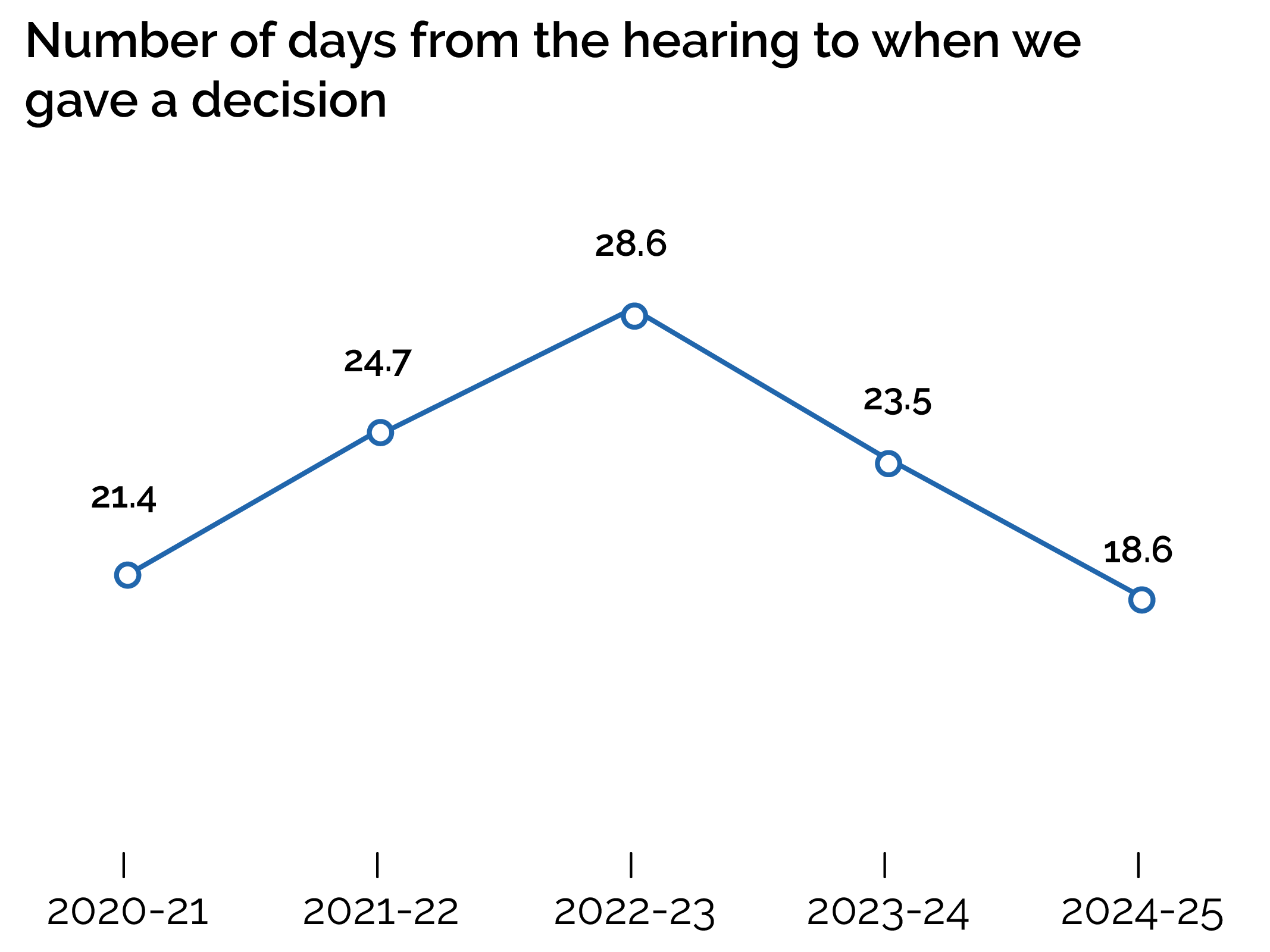
The average time from the final filing deadline to when we gave a decision was 60.7 days. The average time from the hearing to when we gave a decision was 18.6 days.
Text version
Number of days from final filing deadline to when we gave a decision.
In 2020 to 2021, our average was 73.6 days.
In 2021 to 2022, it was 83.7 days.
In 2022 to 2023, it was 126.1 days.
In 2023 to 2024, it was 93.1 days.
In 2024 to 2025, it was 60.7 days.
Text version
Number of days from the hearing to when we gave a decision.
In 2020 to 2021, our average was 21.4 days.
In 2021 to 2022, it was 24.7 days.
In 2022 to 2023, it was 28.6 days.
In 2023 to 2024, it was 23.5.
In 2024 to 2025, it was 18.6 days.
Service standards
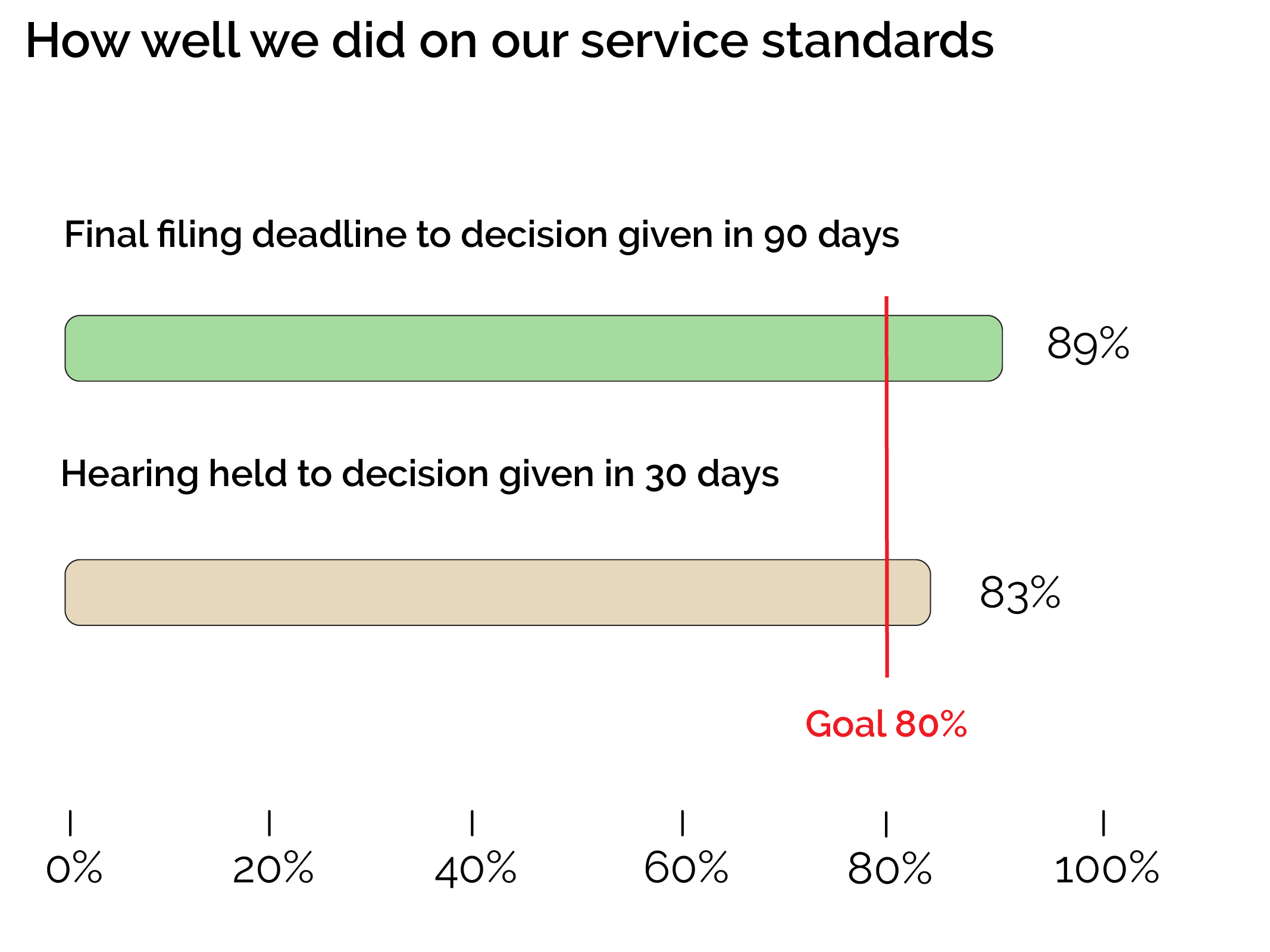
Under our updated service standards, we aim to give the decision within 90 days of the last filing deadline, at least 80% of the time. We also aim to give the decision within 30 days of the hearing, at least 80% of the time. This year we met both of these targets.
Text version
How well we did on our service standards.
We gave the decision within 90 days of the final filing deadline 89% of the time.
We gave the decision within 30 days of the hearing 83% of the time.
Appeal Division
Inventory
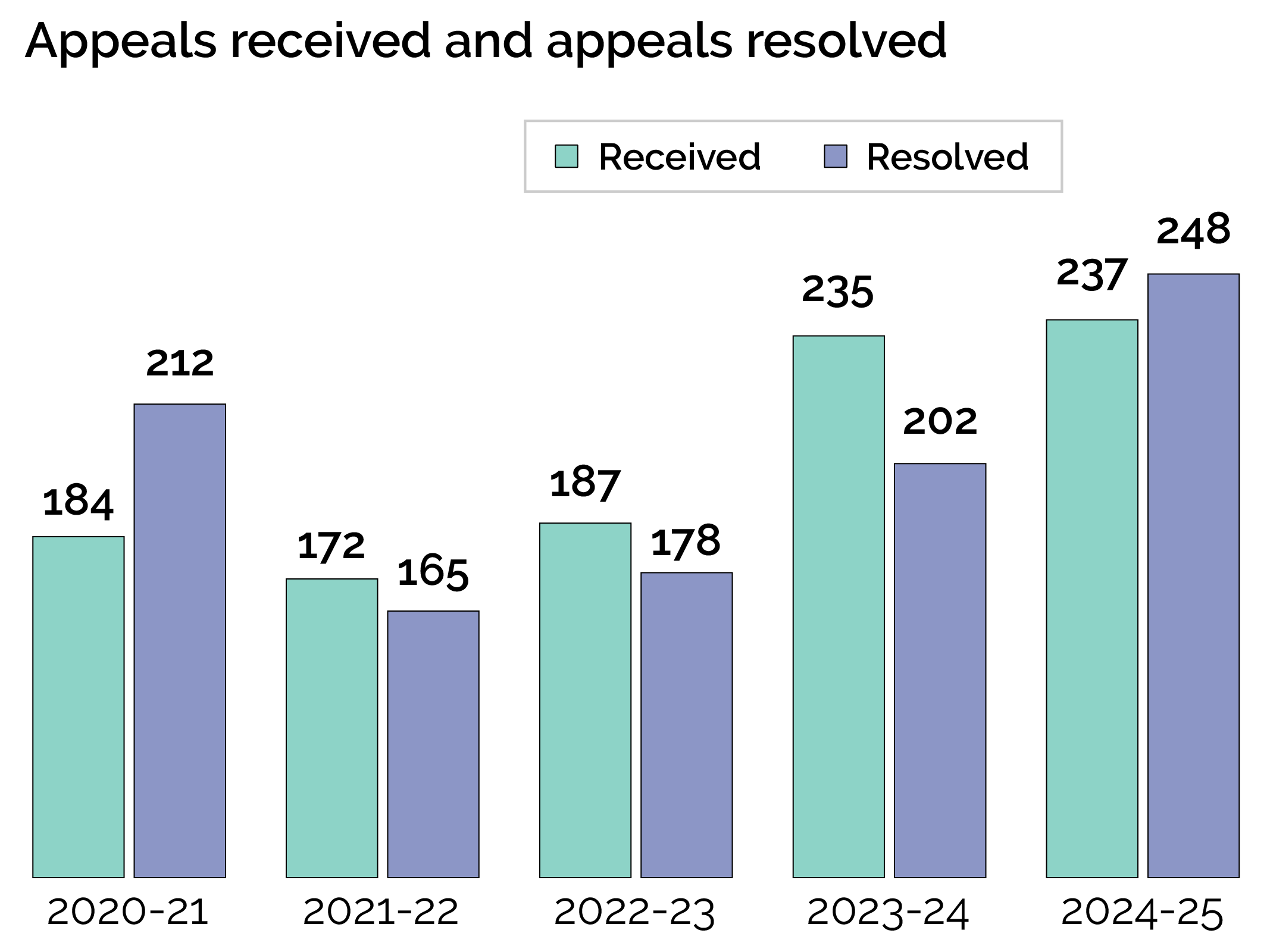
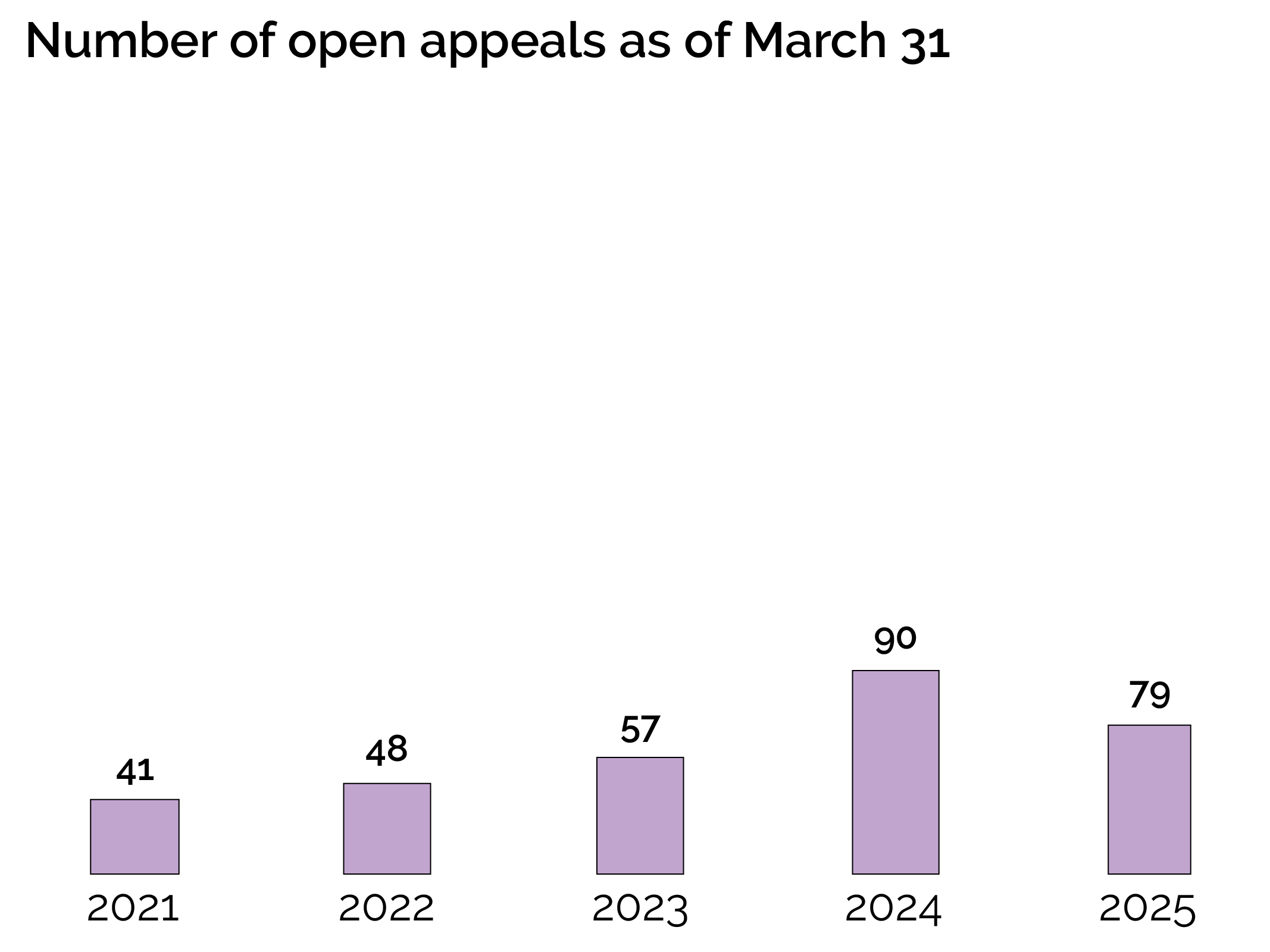
We resolved more appeals than we received this year. Our inventory of open appeals decreased slightly.
Text version
Appeals received and appeals resolved.
In 2020 to 2021, we received 184 appeals and resolved 212.
In 2021 to 2022, we received 172 appeals and resolved 165.
In 2022 to 2023, we received 187 appeals and resolved 178.
In 2023 to 2024, we received 235 appeals and resolved 202.
In 2024 to 2025, we received 237 appeals and resolved 248.
Text version
Number of open appeals as of March 31.
On March 31, 2021, there were 41 open appeals.
On March 31, 2022, there were 48.
On March 31, 2023, there were 57.
On March 31, 2024, there were 90.
On March 31, 2025, there were 79.
Processing times
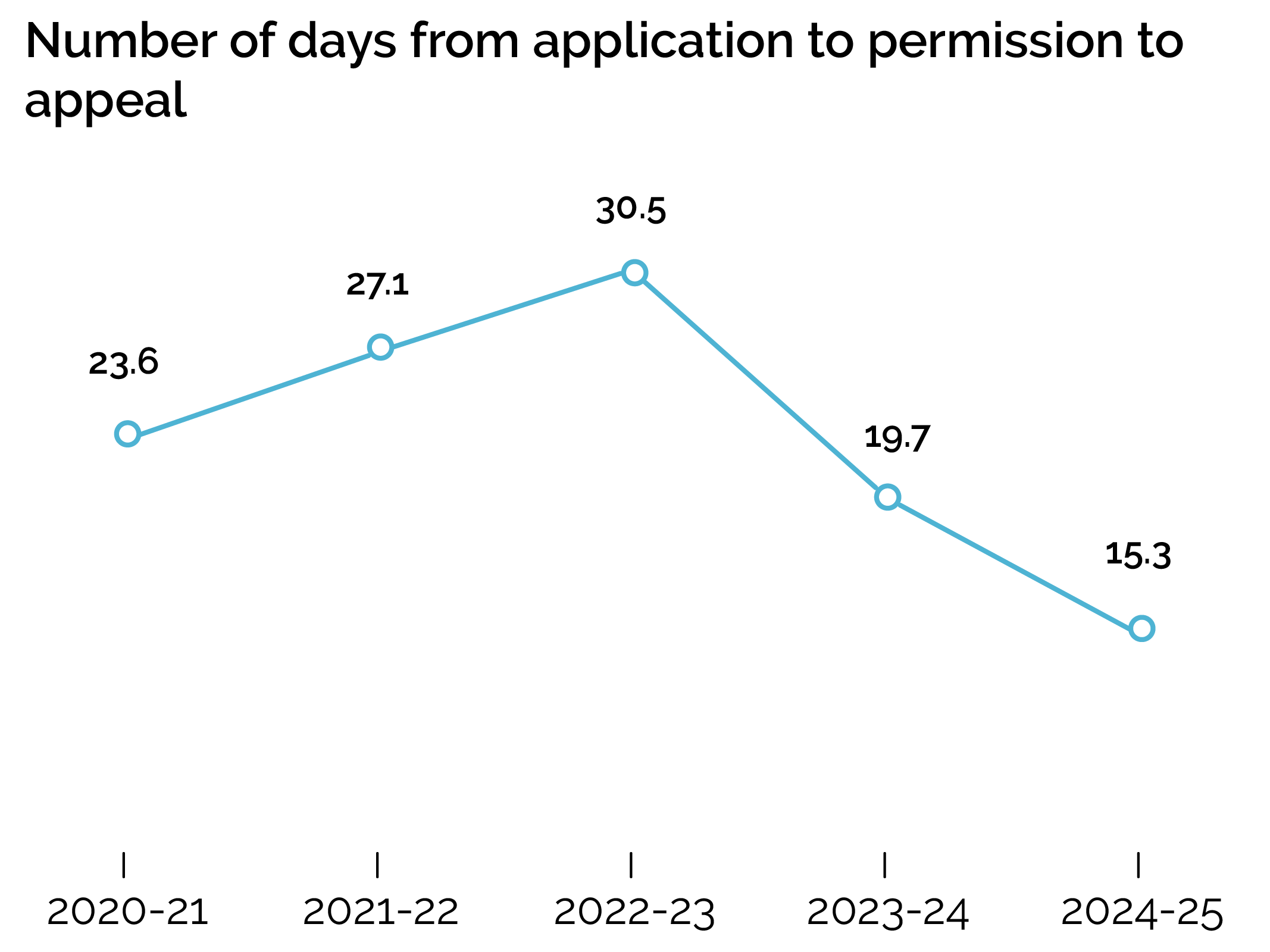
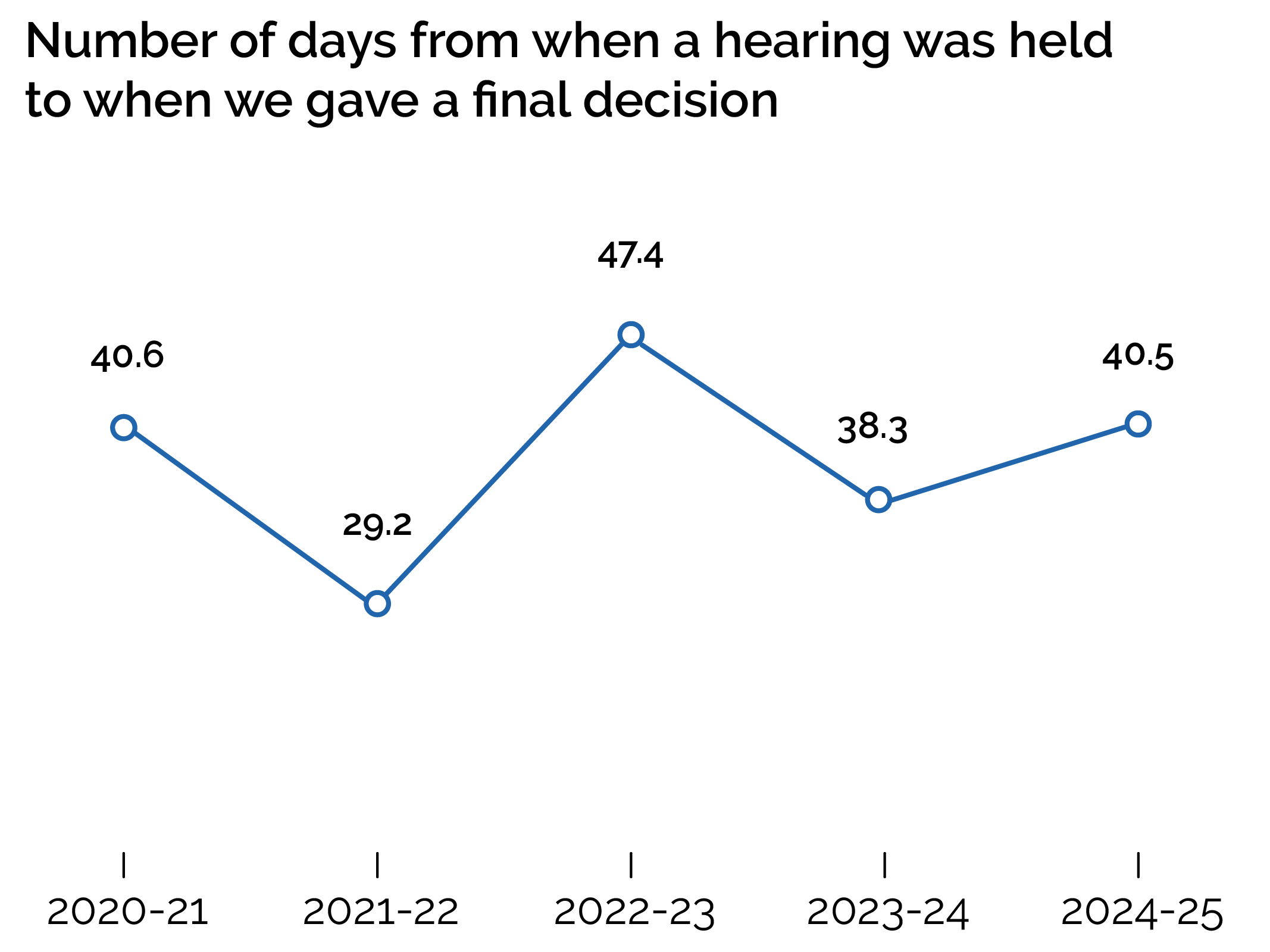
The average time from application to permission to appeal was 15.3 days. The average time from the final filing deadline to the final decision was 75.3 days. The average time from the hearing to the final decision was 40.5 days.
Text version
Number of days from application to permission to appeal.
In 2020 to 2021, the average time was 23.6 days.
In 2021 to 2022, it was 27.1 days.
In 2022 to 2023, it was 30.5 days.
In 2023 to 2024, it was 19.7 days.
In 2024 to 2025, it was 15.3 days.
Text version
Number of days from when a hearing was held to when we gave a final decision.
In 2020 to 2021, the average was 40.6 days.
In 2021 to 2022, it was 29.2 days.
In 2022 to 2023, it was 47.4 days.
In 2023 to 2024, it was 38.3 days.
In 2024 to 2025, it was 40.5 days.
Service standards
Our new service standards reflect recent changes at the Appeal Division: we have new criteria for permission to appeal and hearings are held as a new proceeding. We aim to meet the following timelines 80% of the time:
- Make a decision on permission to appeal within 30 days
- Make the final decision within 90 days of the last filing deadline
- Make the final decision within 60 days from the hearing
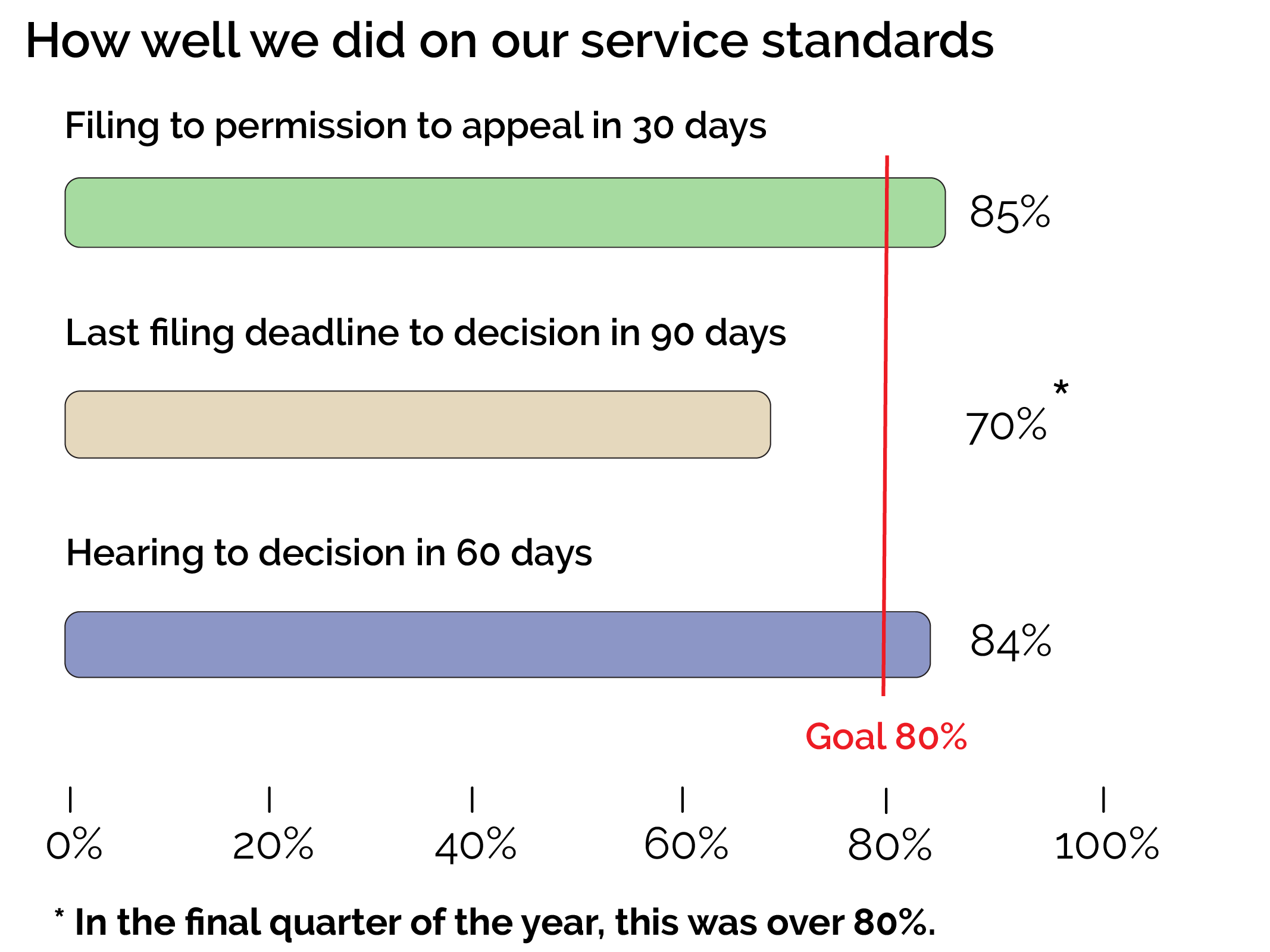
We met 2 of these standards throughout the year and all 3 in the last quarter.
Text version
How well we did on our service standards.
We decided on permission to appeal within 30 days from filing 85% of the time.
We gave the decision within 90 days of the last filing deadline 70% of the time.
We gave the decision within 60 days of the hearing 84% of the time.
Appeal origin

Text version
84.8% of appeals (201 appeals) were started by claimants;
14.4% (34 appeals) were started by the Minister of Employment and Social Development;
0.8% (2 appeals) were started by an added party.
Alternative dispute resolution (ADR)
The Appeal Division brings parties together for alternative dispute resolution when they may be able to resolve the appeal without a hearing. For the 2024 to 25 fiscal year, 20% (51) of concluded Appeal Division Income Security cases went through the ADR process. Of these cases, 78.4% were resolved.
Our Employment Insurance numbers
(Excludes group appeals)
General Division
Inventory
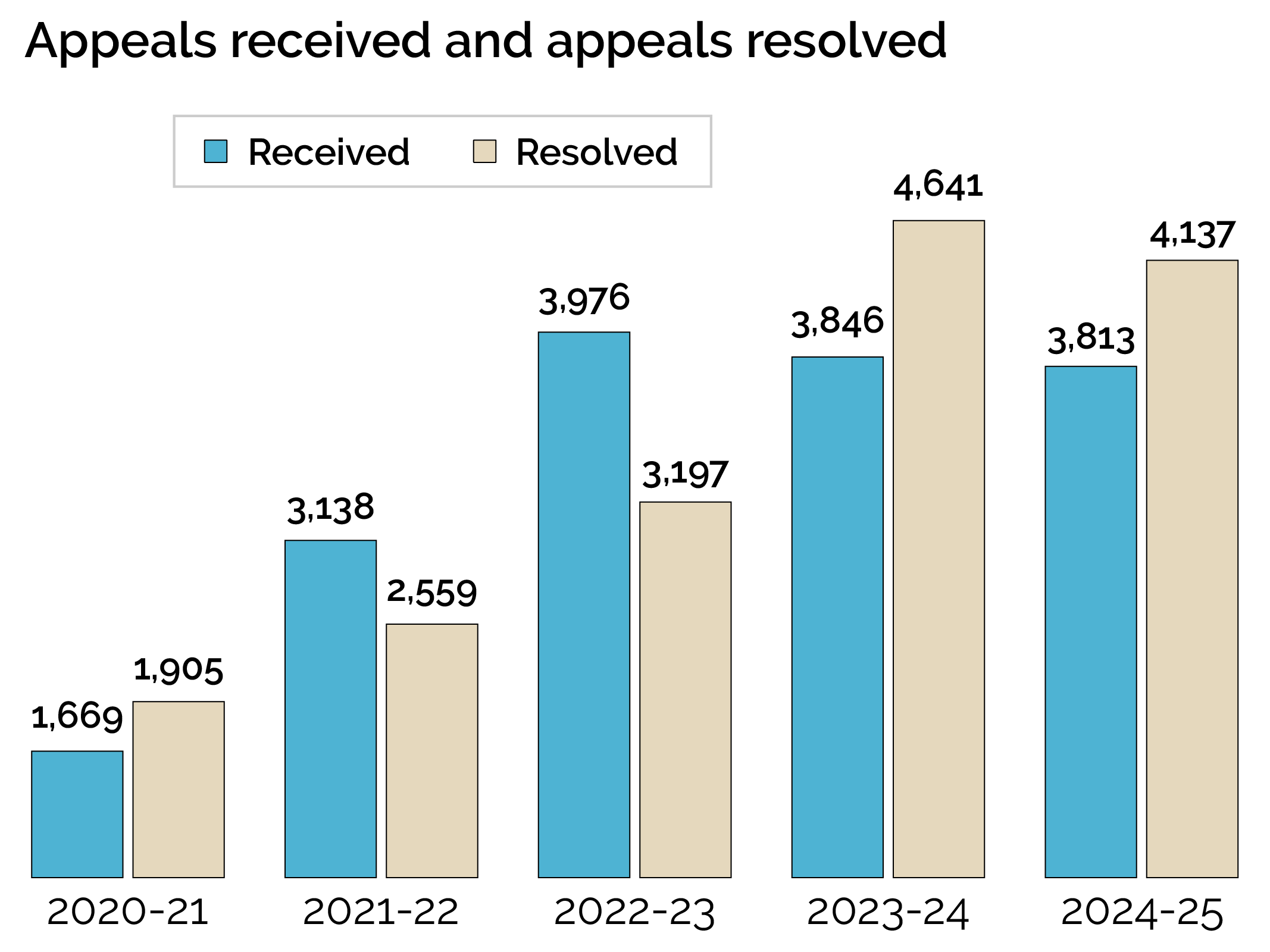
We resolved many more appeals than we received this year. Our inventory of open appeals decreased significantly.
Text version
Appeals received and appeals resolved.
In 2020 to 2021, we received 1,669 appeals and resolved 1,905 appeals.
In 2021 to 2022, we received 3,138 appeals and resolved 2,559.
In 2022 to 2023, we received 3,976 appeals and resolved 3,197.
In 2023 to 2024, we received 3,846 appeals and resolved 4,641.
In 2024 to 2025, we received 3,813 appeals and resolved 4,137.
Text version
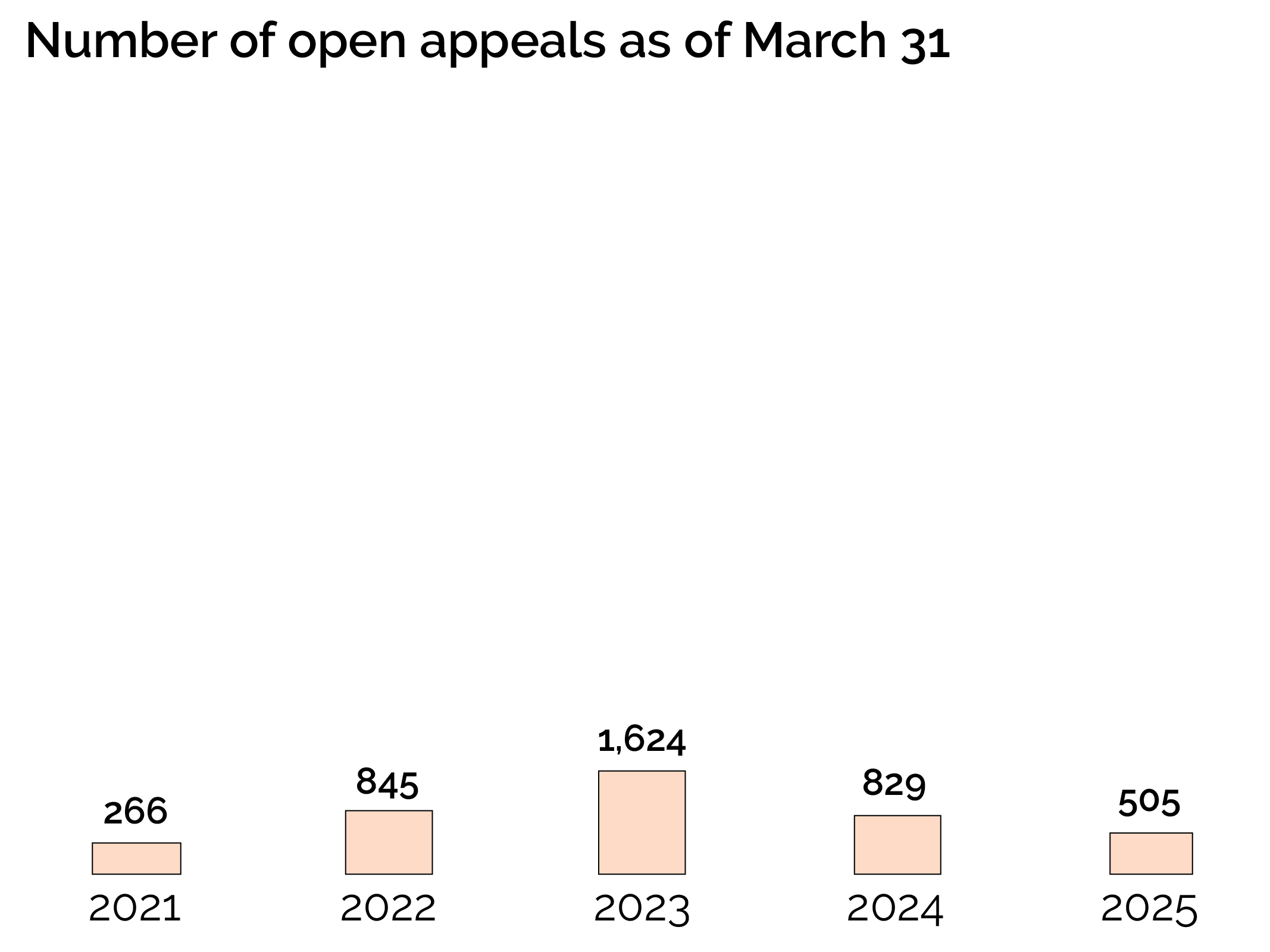
Number of open appeals as of March 31.
On March 31, 2021, there were 266 open appeals.
On March 31, 2022, there were 845.
On March 31, 2023, there were 1,624.
On March 31, 2024, there were 829.
On March 31, 2025, there were 505.
Processing times
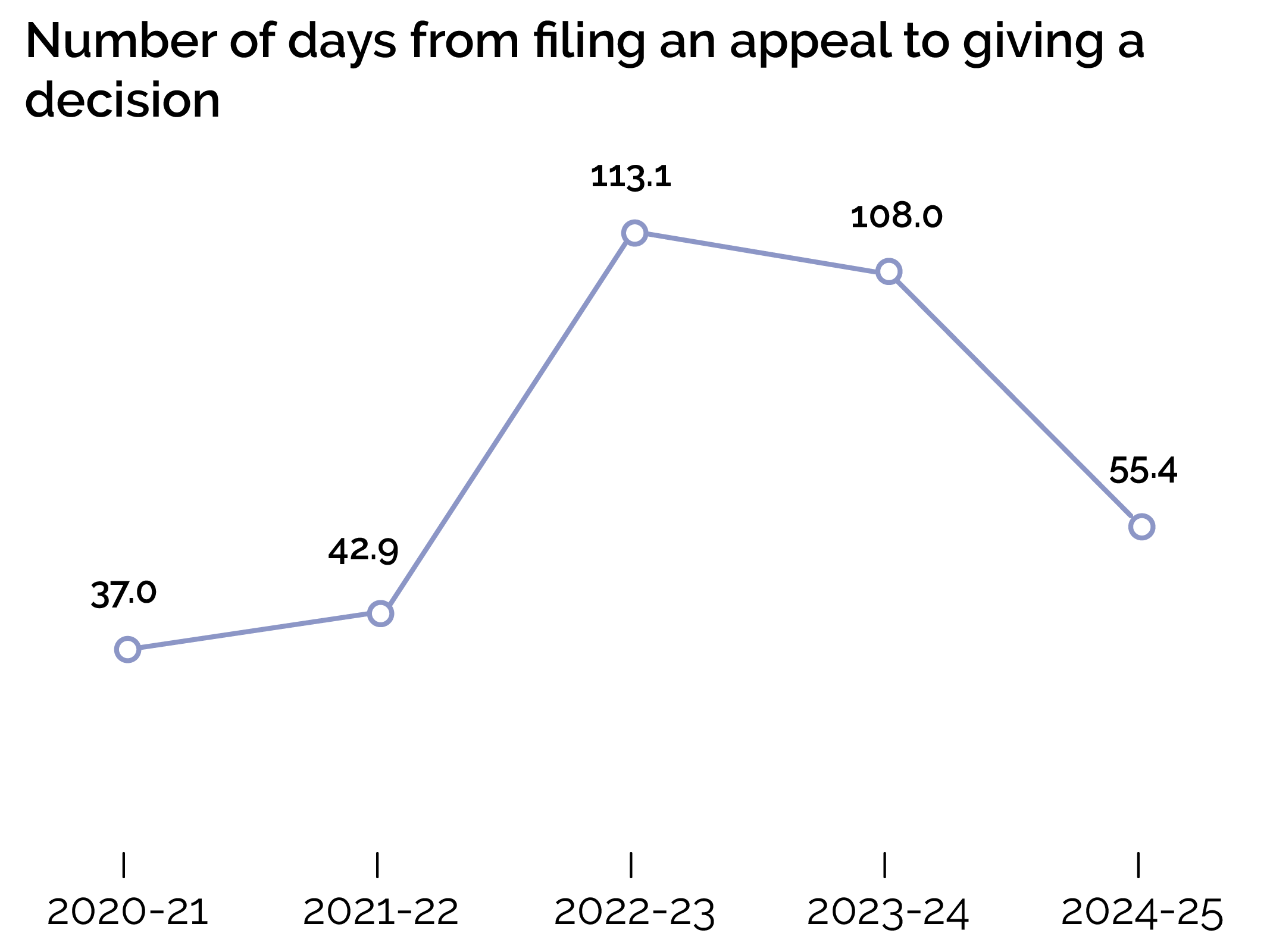
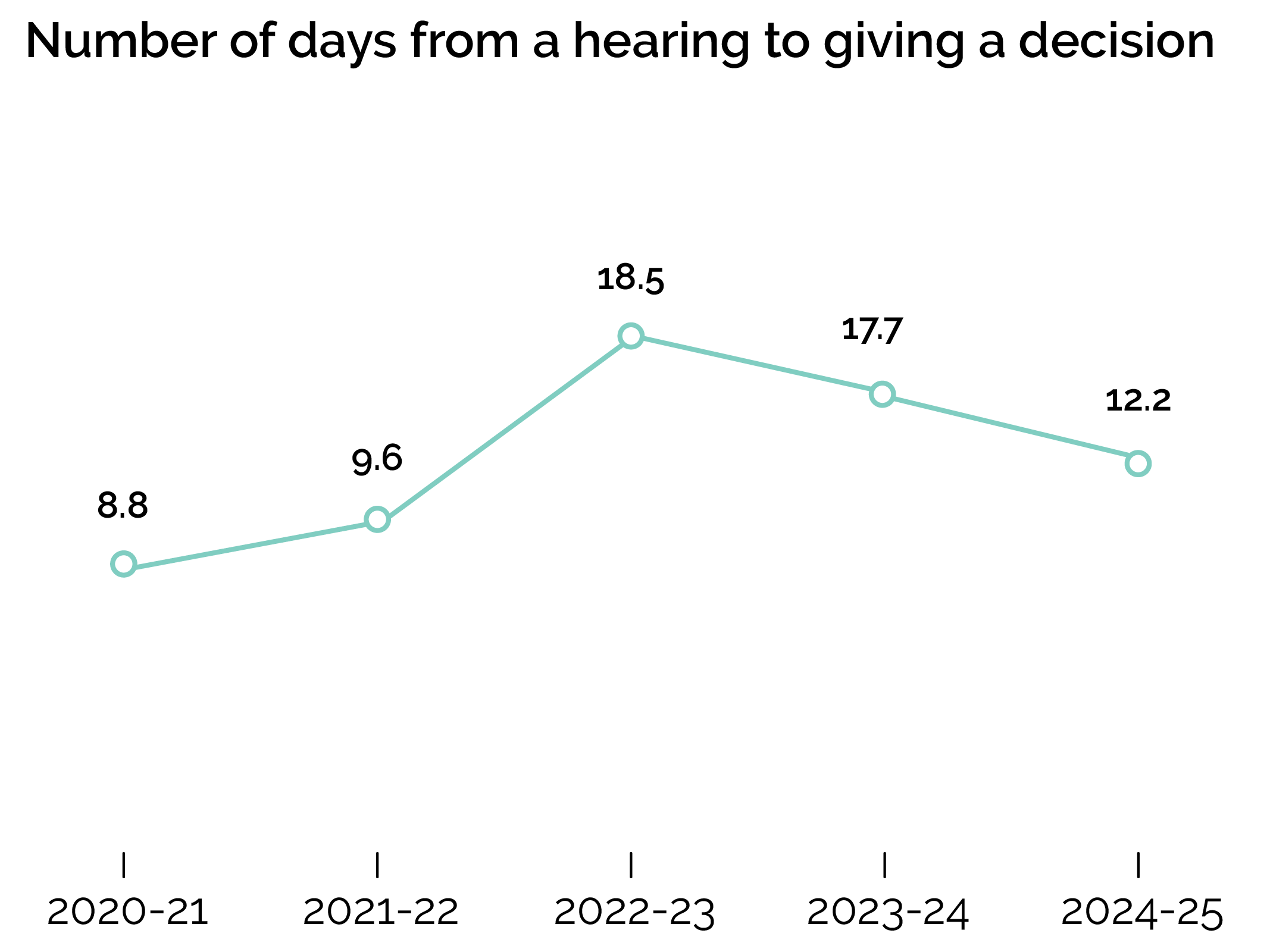
The average time from the filing of the appeal to when we gave a decision was 55.4 days. The average time from the hearing to when we gave a decision was 12.2 days.
Text version
Number of days from filing an appeal to giving a decision.
In 2020 to 2021, the average time was 37.0 days.
In 2021 to 2022, it was 42.9 days.
In 2022 to 2023, it was 113.1 days.
In 2023 to 2024, it was 108.0 days.
In 2024 to 2025, it was 55.4 days.
Text version
Number of days from a hearing to giving a decision.
In 2020 to 2021, the average time was 8.8 days.
In 2021 to 2022, it was 9.6 days.
In 2022 to 2023, it was 18.5 days.
In 2023 to 2024, it was 17.7 days.
In 2024 to 2025, it was 12.2 days.
Service standards
We aim to give appellants their decision within 45 days from when they file their appeal, and within 15 days of their hearing, at least 80% of the time.

Text version
How well we did on our service standards.
We gave the decision within 45 days 48% of the time.
We gave the decision within 15 days of the hearing 76% of the time.
Appeal origin
Most EI appeals at the General Division came from claimants.

Text version
99.2% of appeals (3,782 appeals) were from claimants;
0.8% (31 appeals) were from employers.
Appeal Division
Inventory
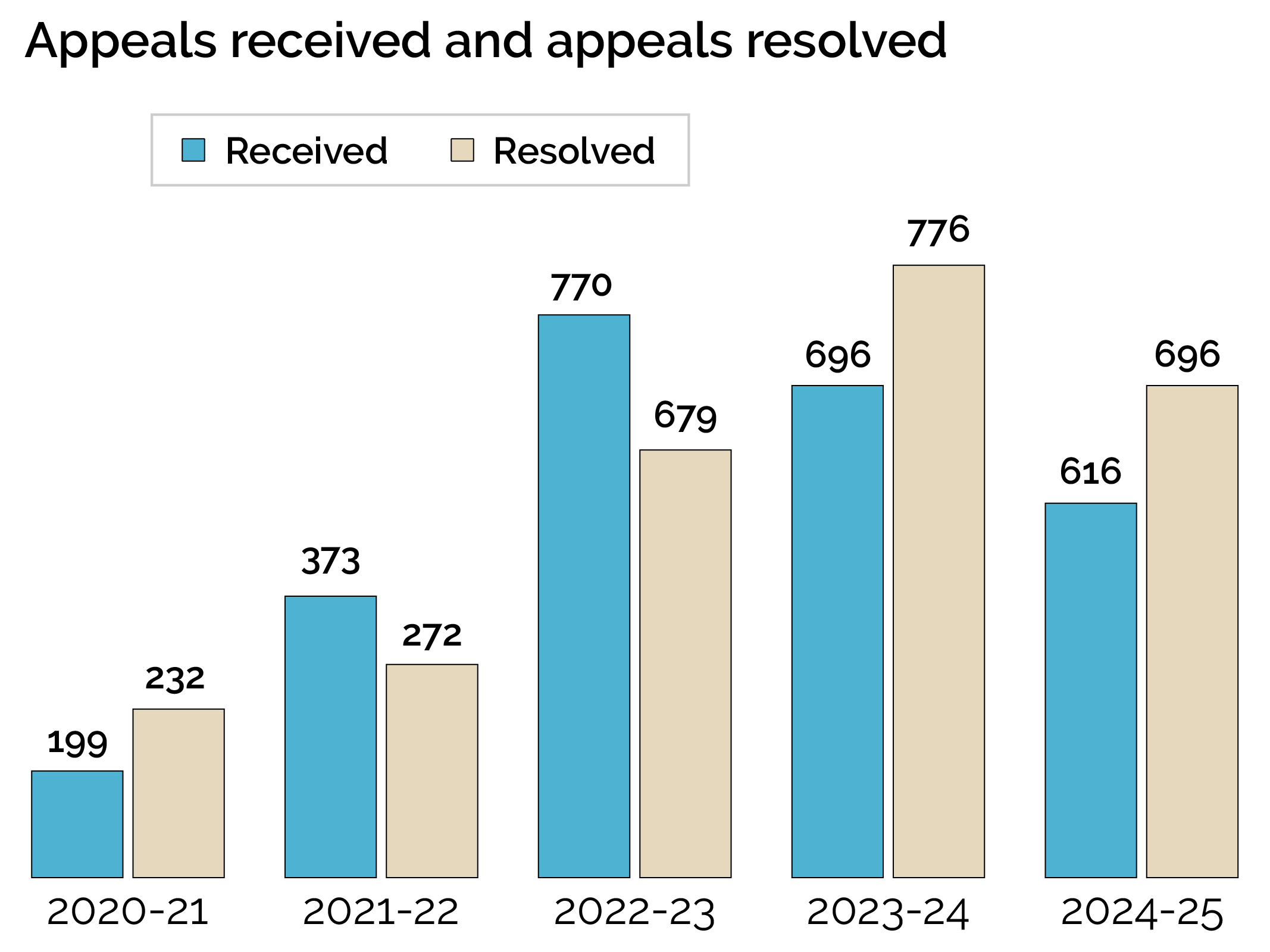
We resolved more cases than we received this year. Our inventory of open appeals decreased significantly.
Text version
Appeals received and resolved.
In 2020 to 2021, we received 199 appeals and resolved 232 appeals.
In 2021 to 2022, we received 373 appeals and resolved 272.
In 2022 to 2023, we received 770 appeals and resolved 679.
In 2023 to 2024, we received 696 appeals and resolved 776.
In 2024 to 2025, we received 616 appeals and resolved 696.
Text version
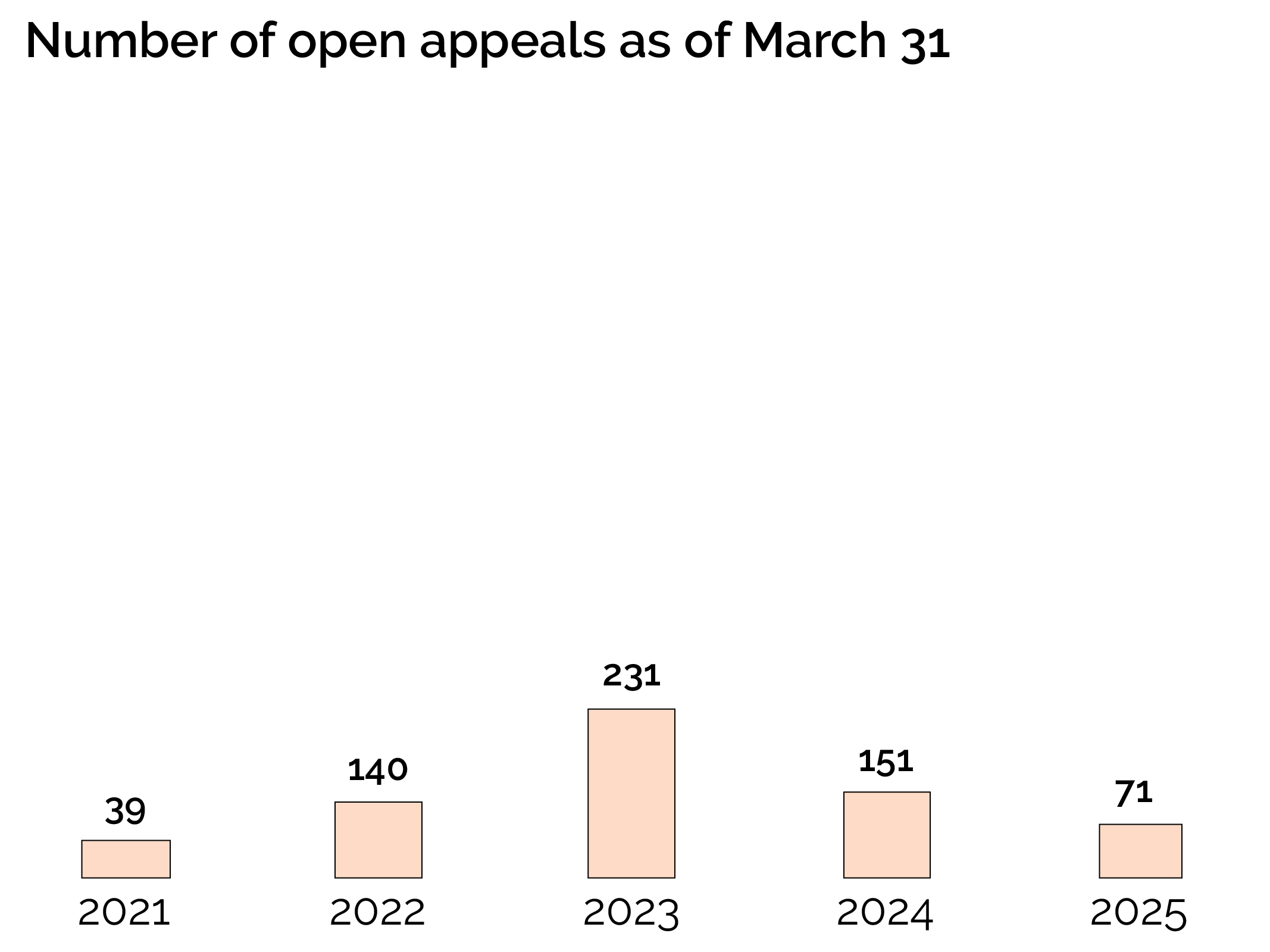
Number of open appeals as of March 31.
On March 31, 2021, there were 39 open appeals.
On March 31, 2022, there were 140.
On March 21, 2023, there were 231.
On March 31, 2024, there were 151.
On March 31, 2025, there were 71.
Processing times
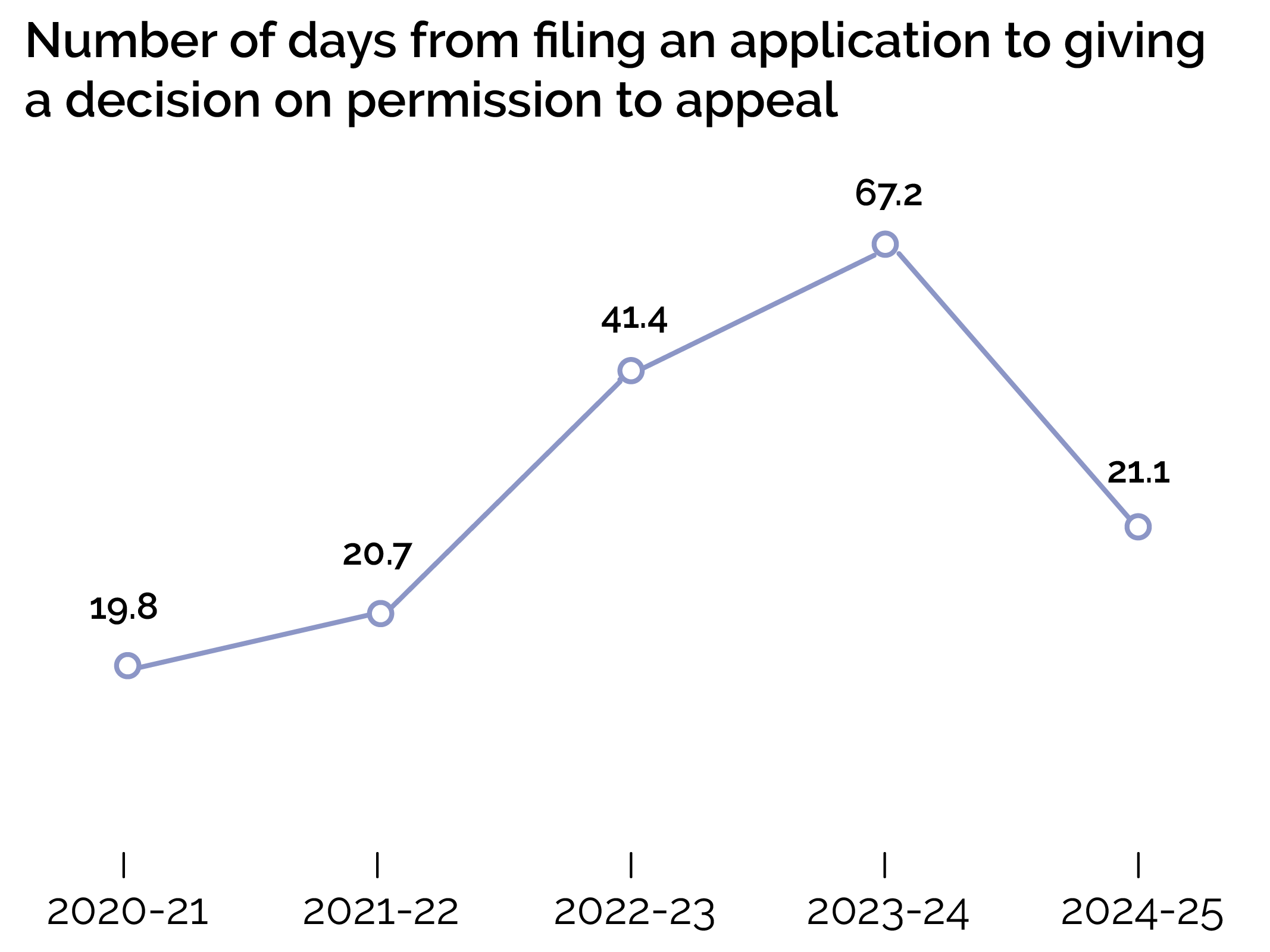
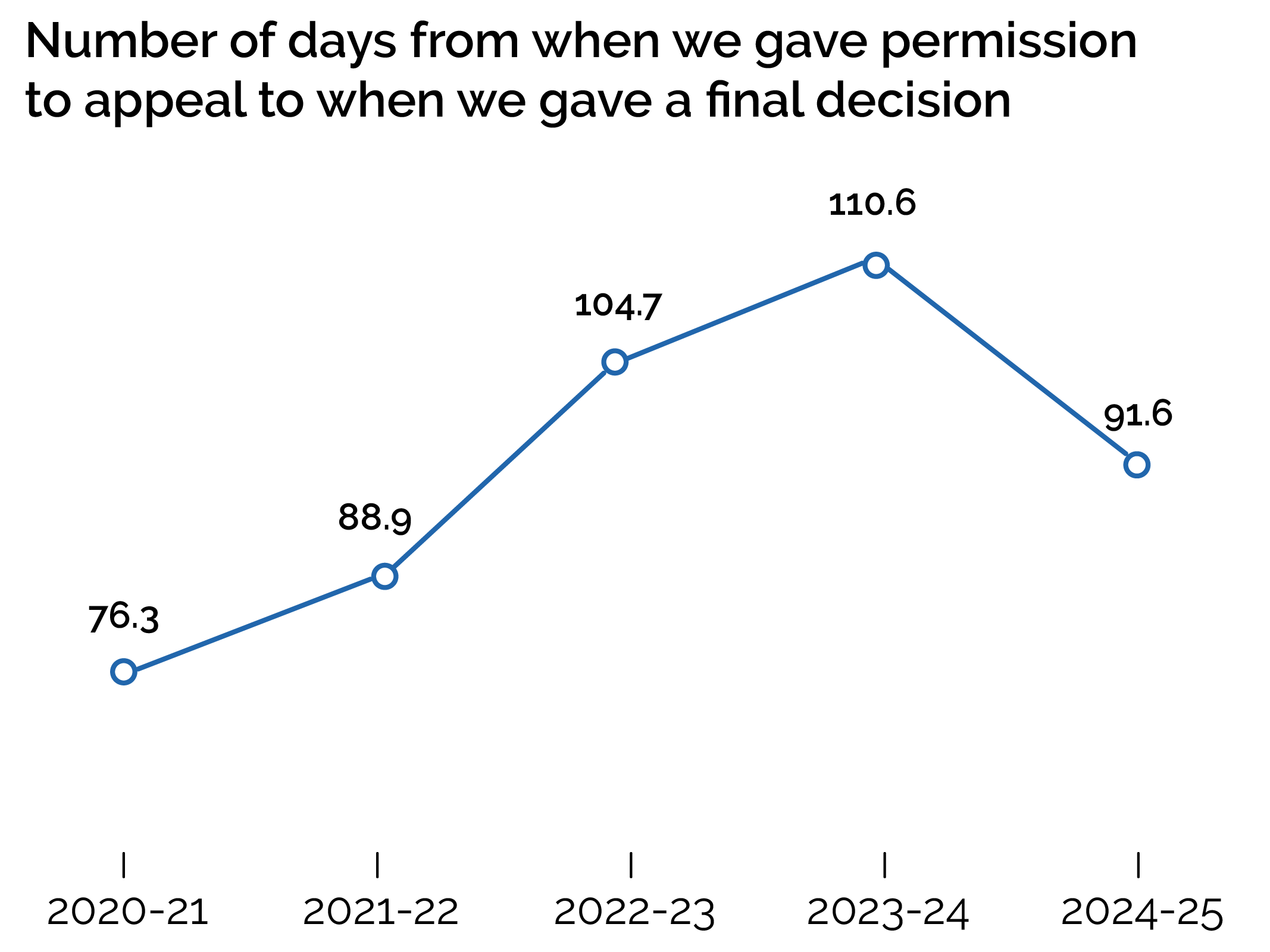
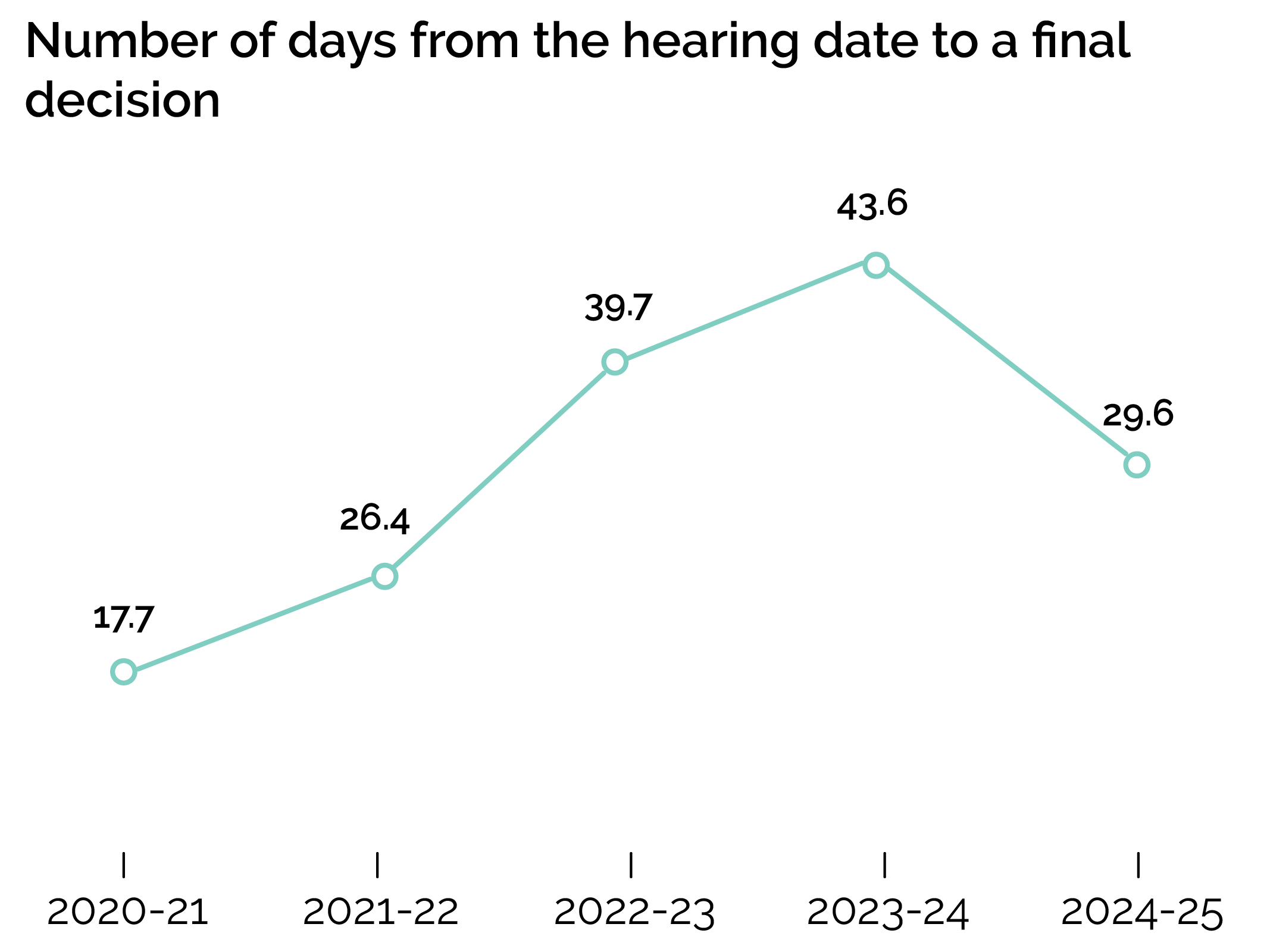
This year, an average of 21.1 days passed from filing an application for permission to appeal to giving a decision on permission to appeal. The average time from giving permission to appeal to giving a final decision was 91.6 days. On average, it took 29.6 days to give a final decision after a hearing.
Text version
Number of days from filing an application to giving a decision on permission to appeal.
In 2020 to 2021, the average time was 19.8 days.
In 2021 to 2022, it was 20.7 days.
In 2022 to 2023, it was 41.4 days.
In 2023 to 2024, it was 67.2 days.
In 2024 to 2025, it was 21.1 days.
Text version
Number of days from when we gave permission to appeal to when we gave a final decision.
In 2020 to 2021, the average was 76.3 days.
In 2021 to 2022, it was 88.9 days.
In 2022 to 2023, it was 104.7 days.
In 2023 to 2024, it was 110.6 days.
In 2024 to 2025, it was 91.6 days.
Text version
Number of days from the hearing date to a final decision.
In 2020 to 2021, the average time was 17.7 days.
In 2021 to 2022, it was 26.4 days.
In 2022 to 2023, it was 39.7 days.
In 2023 to 2024, it was 43.6 days.
In 2024 to 2025, it was 29.6 days.
Service standards
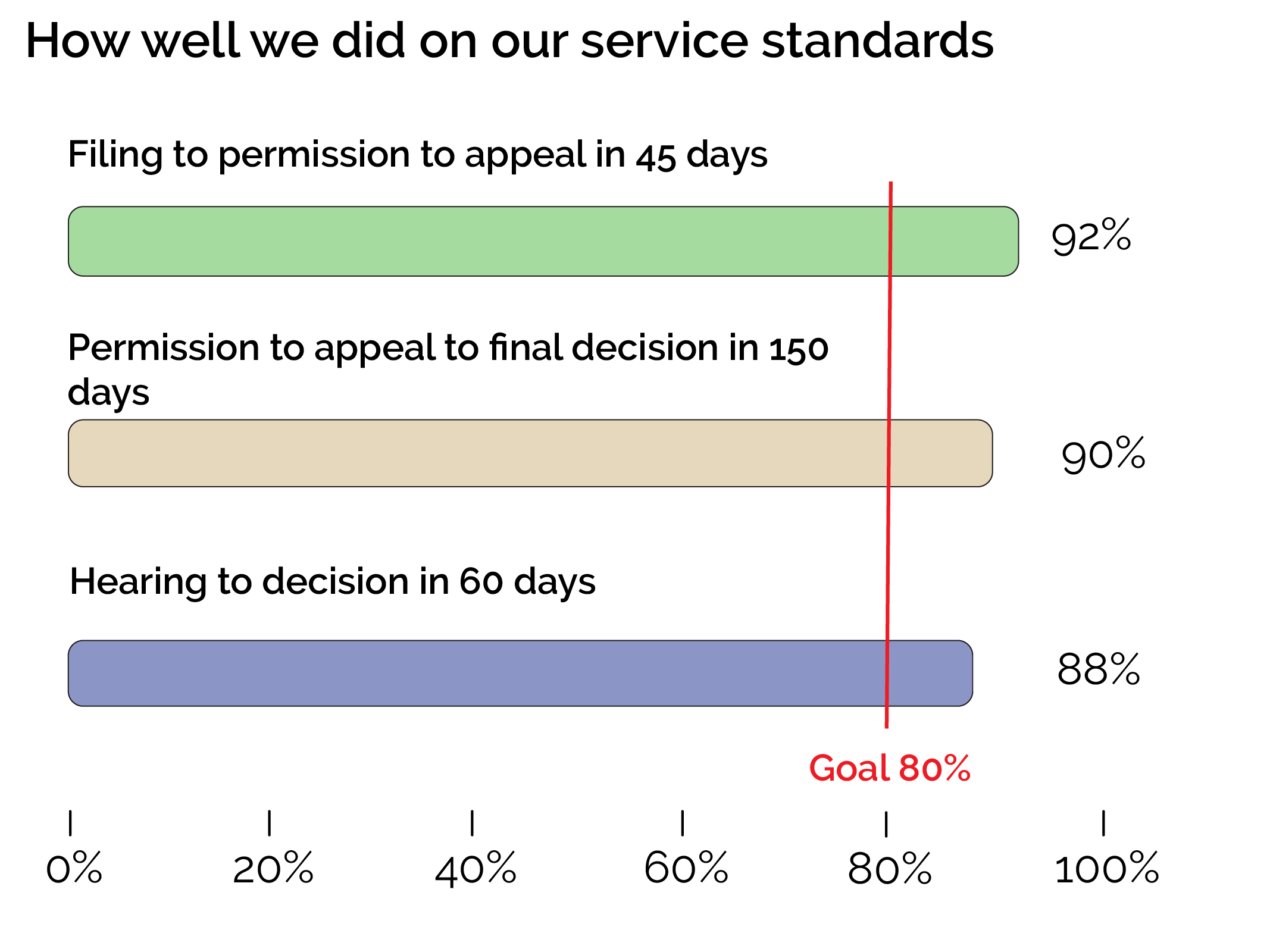
We aim to give appellants a decision about permission to appeal within 45 days of filing an appeal, at least 80% of the time. We aim to make the final decision within 150 days of getting permission to appeal, and within 60 days of the hearing, at least 80% of the time. We met all of these standards.
Text version
How well we did on our service standards.
We decided on permission to appeal within 45 days 92% of the time.
We gave the decision within 150 days of permission to appeal 90% of the time.
We gave the decision within 60 days of the hearing 88% of the time.
Appeal origin
Most EI appeals at the Appeal Division were started by claimants.

Text version
88.3% of appeals (554 appeals) were from claimants;
11.2% (69 appeals) were from the Canada Employment Insurance Commission;
0.5% (3 appeals) were from the employer.
Alternative Dispute Resolution
The Appeal Division brings parties together for alternative dispute resolution (ADR) when they may be able to resolve the appeal without a hearing. This year, 6% (39) of EI cases went through ADR, and 61.5% of those were resolved.
Group appeals
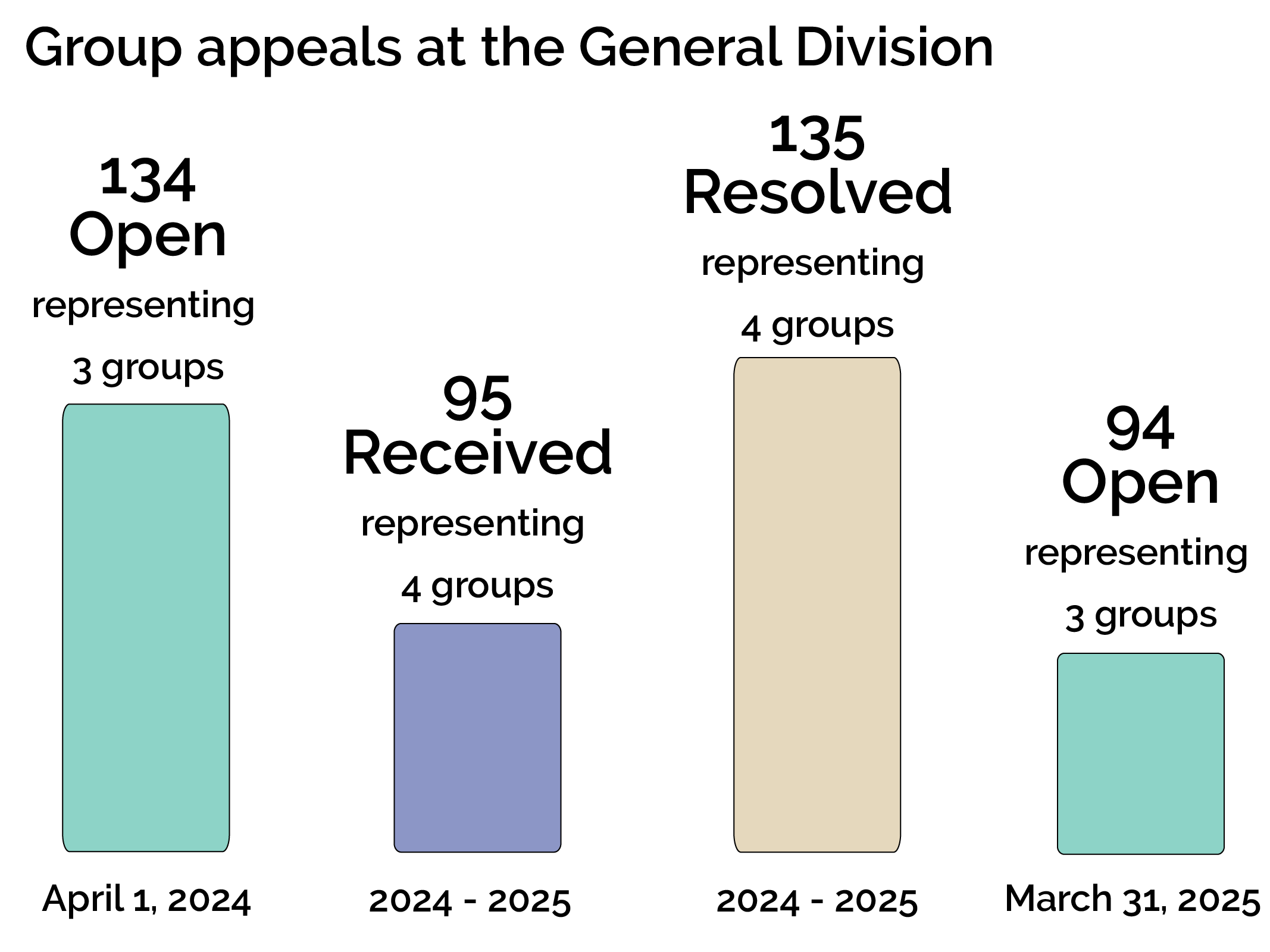
Group appeals usually involve a single employment situation that affects many people. We track these appeals separately because they don’t represent typical appeal timelines. The volume of appeals may be high within a group, but there’s only one hearing for the group and typically only one decision.
Text version
Group appeals at the General Division.
On April 1, 2024, there were 134 open group appeals, representing 3 groups.
In 2024 to 2025, we received 95 group appeals, representing 4 groups.
In 2024 to 2025, we resolved 135 group appeals, representing 4 groups.
On March 31, 2025, there were 94 open group appeals, representing 3 groups.
Text version
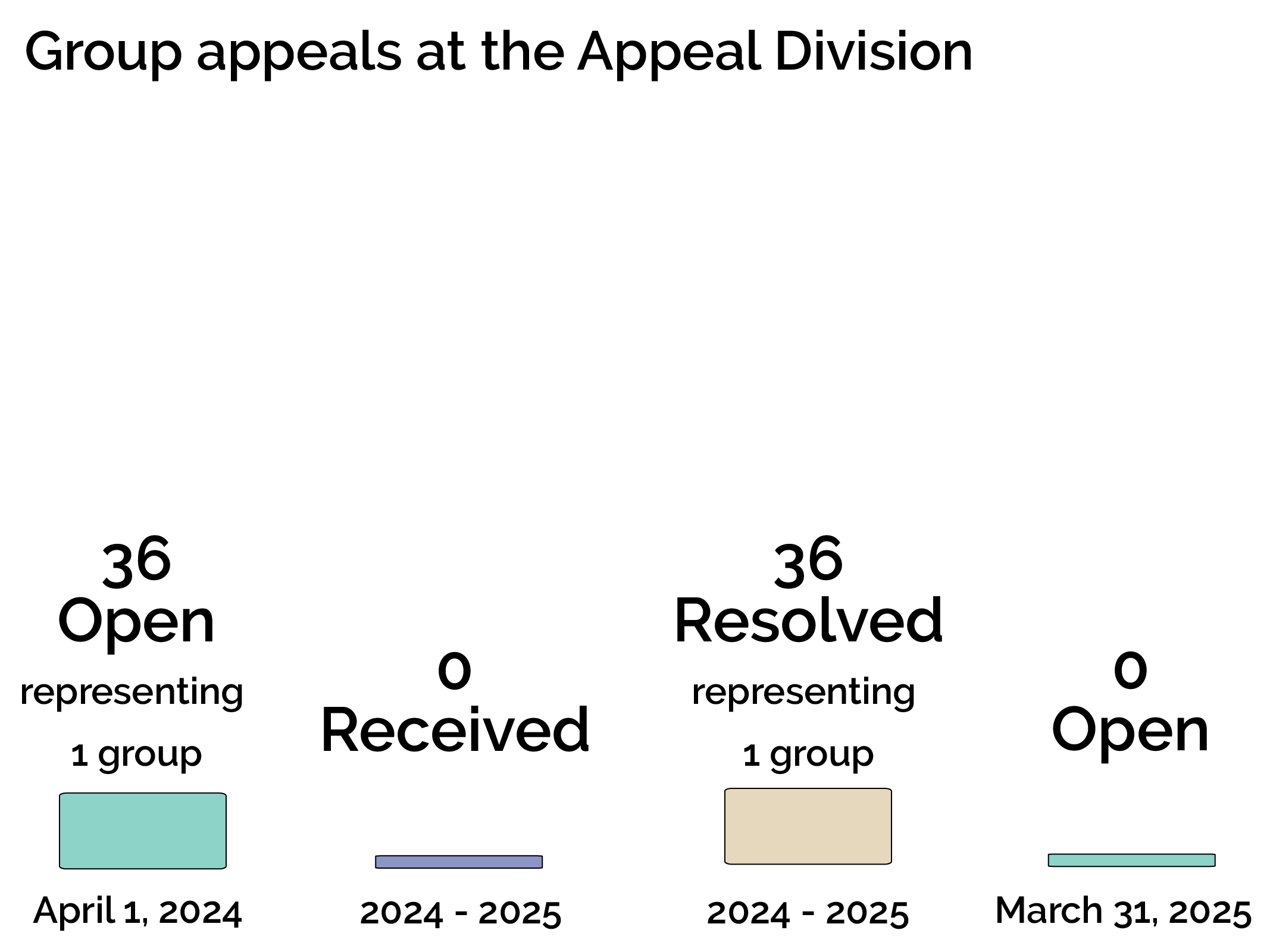
Group appeals at the Appeal Division.
On April 1, 2024, there were 36 open group appeals, representing 1 group.
In 2024 to 2025, we received no group appeals.
In 2024 to 2025, we resolved 36 group appeals, representing 1 group.
On March 31, 2025, there were no open group appeals.